诬 (wū) means "to slander" in Chinese. It has 9 strokes with the radical 讠.
Rated 3.7/5 in difficulty (challenging).
Appears in 3+ common words including 诬告 (wū gào), 诬陷 (wū xiàn), 诬赖 (wū lài).
Due to its 9 strokes, Hanzi Writer's error detection shows 诬 requires focused practice — most learners need 10+ attempts for consistent accuracy.
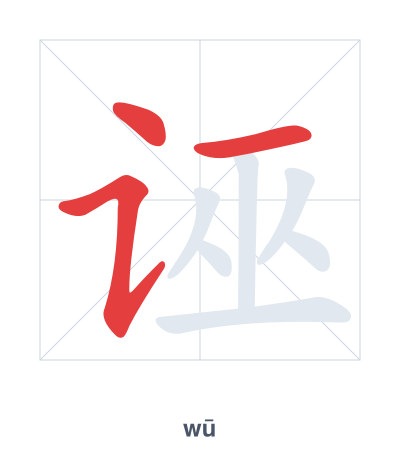
Open Hanzi Writer to see the animated stroke order and practice writing 诬 with real-time feedback.
The character 诬 (wū) is written with 9 strokes. Follow the standard Chinese stroke order: top to bottom, left to right, outside before inside. The radical 讠 is one of its key components.
Practice the correct stroke order with the Hanzi Writer app to see animated stroke-by-stroke guidance with real-time feedback.
诬 means to slander.
诬 combines the radical 讠 (speech) with 巫 (wū, shaman) as a phonetic component. The shaman was historically associated with deceptive or superstitious claims, so using words like a shaman's lies implies slander or false accusation.
💡 Memory Tip: Picture a shaman (巫) chanting falsehoods (讠) to slander an innocent villager.
他被人诬告了。
tā bèi rén wū gào le
He was falsely accused by someone.
这是恶意的诬陷。
zhè shì è yì de wū xiàn
This is a malicious frame-up.
你不要诬赖好人。
nǐ bú yào wū lài hǎo rén
Don't falsely accuse innocent people.
Open Hanzi Writer to see the animated stroke order and practice writing 诬 with real-time feedback.
✨ Animated stroke order · Handwriting recognition · HSK-graded practice · Free to use
The character 诬 is composed of the radical 讠 (speech) on the left and 巫 (wū, sorcerer) on the right. Since 讠 relates to words or speech, and 巫 suggests something false or cunning, the combined meaning is using speech to deceive or slander.