计 (jì) means "to count; plan; strategy" in Chinese. It has 4 strokes with the radical 讠, and is HSK Level 2.
Rated 1.9/5 in difficulty (beginner-friendly).
Harder than 7% of HSK Level 2 characters.
Appears in 3+ common words including 计划 (jì huà), 计算 (jì suàn), 设计 (shè jì).
In the Hanzi Writer app, most learners master 计 within 3 practice attempts using stroke-by-stroke animation.
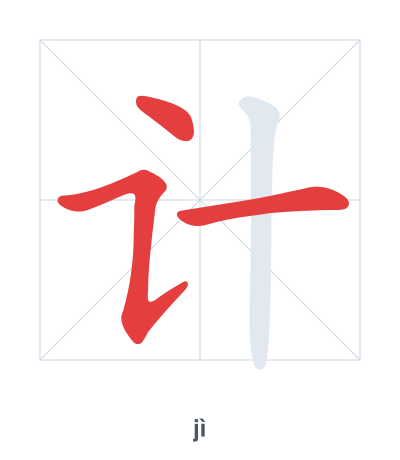
Open Hanzi Writer to see the animated stroke order and practice writing 计 with real-time feedback.
The character 计 (jì) is written with 4 strokes. Follow the standard Chinese stroke order: top to bottom, left to right, outside before inside. The radical 讠 is one of its key components.
Practice the correct stroke order with the Hanzi Writer app to see animated stroke-by-stroke guidance with real-time feedback.
计 means to count; plan; strategy.
As an HSK Level 2 character, 计 is among the first characters beginners learn.
计 is a compound character combining the speech radical 讠 (言) with 十 (ten). The character suggests 'counting with words' or 'making a plan by speaking', as ten (十) can represent a total or a number being calculated. It originally conveyed the idea of calculating or devising a strategy through verbal discussion.
💡 Memory Tip: Imagine a speech bubble (讠) with ten (十) tally marks inside, as you count them aloud to form a plan.
我有一个旅游计划。
wǒ yǒu yí gè lǚ yóu jì huà
I have a travel plan.
他在计算这道数学题。
tā zài jì suàn zhè dào shù xué tí
He is calculating this math problem.
她设计了一件新衣服。
tā shè jì le yī jiàn xīn yī fú
She designed a new piece of clothing.
Open Hanzi Writer to see the animated stroke order and practice writing 计 with real-time feedback.
✨ Animated stroke order · Handwriting recognition · HSK-graded practice · Free to use
计 combines the speech radical 讠 on the left with the number ten 十 on the right. The speech radical suggests verbal expression, while ten represents numbers or counting, together forming the idea of 'counting' or 'planning' with words or numbers.