讥 (jī) means "to ridicule; to mock" in Chinese. It has 4 strokes with the radical 讠, and is HSK Level 7.
Rated 2.4/5 in difficulty (moderate).
Harder than 3% of HSK Level 7 characters.
Appears in 3+ common words including 讥笑 (jī xiào), 讥讽 (jī fěng), 讥评 (jī píng).
Hanzi Writer's stroke validation shows learners typically need 5-8 attempts to write 讥 with correct proportion and order.
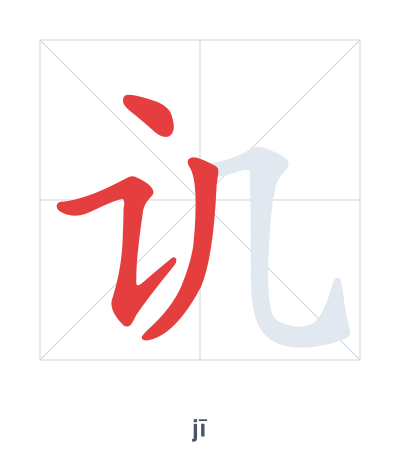
Open Hanzi Writer to see the animated stroke order and practice writing 讥 with real-time feedback.
The character 讥 (jī) is written with 4 strokes. Follow the standard Chinese stroke order: top to bottom, left to right, outside before inside. The radical 讠 is one of its key components.
Practice the correct stroke order with the Hanzi Writer app to see animated stroke-by-stroke guidance with real-time feedback.
讥 means to ridicule; to mock.
As an HSK Level 7 character, 讥 is an intermediate-level character.
The character 讥 is a simplified form of 譏, combining the speech radical 讠 (言) with 几 (jī), which serves as a phonetic component. The original right side 幾 meant 'subtle' or 'slight,' suggesting indirect or pointed speech that ridicules or mocks. Today, the structure visually links speaking (讠) to a minimal element (几), hinting at sharp or belittling comments.
💡 Memory Tip: Imagine a person talking (讠) while mockingly pointing at a tiny table (几), saying, 'Look at that ridiculous little thing!'
不要讥笑别人的错误。
bú yào jī xiào bié rén de cuò wù
Don't mock others' mistakes.
他的话里带着讥讽。
tā de huà lǐ dài zhe jī fěng
There was sarcasm in his words.
他总是讥评别人。
tā zǒng shì jī píng bié rén
He is always criticizing others mockingly.
Open Hanzi Writer to see the animated stroke order and practice writing 讥 with real-time feedback.
✨ Animated stroke order · Handwriting recognition · HSK-graded practice · Free to use
讥 is a semantic-phonetic compound. The left radical 讠 means speech or words, which relates to the act of mocking or ridiculing through language. The right part 几 provides the pronunciation jī, though its original meaning as a small table is not directly related.