偏 (piān) means "slanted; biased; stubbornly" in Chinese. It has 11 strokes with the radical 亻, and is HSK Level 6.
Rated 3.9/5 in difficulty (challenging).
Harder than 38% of HSK Level 6 characters.
Appears in 3+ common words including 偏心 (piān xīn), 偏见 (piān jiàn), 偏偏 (piān piān).
Due to its 11 strokes, Hanzi Writer's error detection shows 偏 requires focused practice — most learners need 10+ attempts for consistent accuracy.
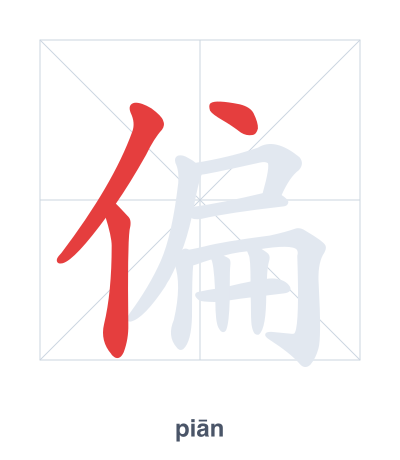
Open Hanzi Writer to see the animated stroke order and practice writing 偏 with real-time feedback.
The character 偏 (piān) is written with 11 strokes. Follow the standard Chinese stroke order: top to bottom, left to right, outside before inside. The radical 亻 is one of its key components.
Practice the correct stroke order with the Hanzi Writer app to see animated stroke-by-stroke guidance with real-time feedback.
偏 means slanted; biased; stubbornly.
As an HSK Level 6 character, 偏 is an intermediate-level character.
偏 is a phono-semantic compound: the radical 亻 (person) indicates a human action or trait, while 扁 (biǎn, 'flat' or 'side') provides the sound and hints at being tilted or off-center. Together, they evoke a person leaning to one side—slanted or biased in posture or opinion.
💡 Memory Tip: Imagine a person (亻) leaning sideways next to a flat board (扁) because they stubbornly refuse to stand straight.
爸爸从不偏心。
bà bà cóng bù piān xīn
Dad is never partial.
我们不应该有偏见。
wǒ men bù yīng gāi yǒu piān jiàn
We should not have prejudices.
偏偏今天下雨了。
piān piān jīn tiān xià yǔ le
As luck would have it, it rained today.
Open Hanzi Writer to see the animated stroke order and practice writing 偏 with real-time feedback.
✨ Animated stroke order · Handwriting recognition · HSK-graded practice · Free to use
偏 is made of the radical 亻 (person) on the left and 扁 (flat) on the right. A person leaning to one side creates a slanted or biased position, which relates to the meanings of slanted, biased, and stubbornly.