Hanzi Writer

How to Write 摆 (bǎi) — Meaning “to place; to sway; to display”

bǎi HSK Level 4 13 strokes Radical: 扌

摆 (bǎi) means "to place; to sway; to display" in Chinese. It has 13 strokes with the radical 扌, and is HSK Level 4.

Rated 4.2/5 in difficulty (advanced).

Harder than 71% of HSK Level 4 characters.

Appears in 3+ common words including 摆放 (bǎi fàng), 摆手 (bǎi shǒu), 摇摆 (yáo bǎi).

Due to its 13 strokes, Hanzi Writer's error detection shows 摆 requires focused practice — most learners need 10+ attempts for consistent accuracy.
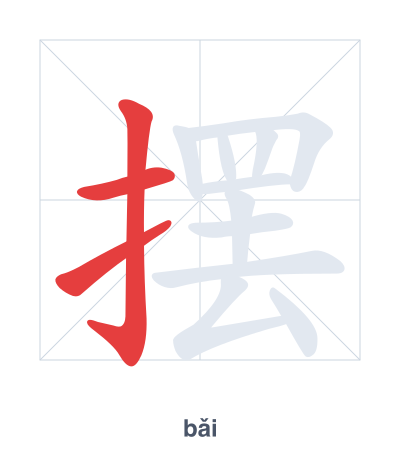
Stroke order practice for 摆 - bǎi

Practice Writing 摆 (bǎi)

Open Hanzi Writer to see the animated stroke order and practice writing 摆 with real-time feedback.

The character (bǎi) is written with 13 strokes. Follow the standard Chinese stroke order: top to bottom, left to right, outside before inside. The radical is one of its key components.

Practice the correct stroke order with the Hanzi Writer app to see animated stroke-by-stroke guidance with real-time feedback.

means to place; to sway; to display.

As an HSK Level 4 character, is an intermediate-level character.

Character
Pinyinbǎi (bai)
Meaningto place; to sway; to display
Strokes13
Radical
HSK Level4
Difficulty4.2/5

The character 摆 is a phono-semantic compound combining the hand radical 扌, indicating an action involving the hand, and the phonetic component 罢 (bà), meaning 'to stop' or 'cease.' Originally it referred to arranging or setting items down with the hand, as in placing objects for display; later it also acquired the sense of 'to sway,' perhaps from the hand motion of adjusting placement.

💡 Memory Tip: With your hand (扌), you stop (罢) to place an object, then give it a gentle sway to check its position.

bǎi fàng
to arrange; to set out
bǎi shǒu
to wave one's hand
yáo bǎi
to swing; to sway; to waver

桌上摆放着几本书。

zhuō shàng bǎi fàng zhe jǐ běn shū

There are a few books on the table.

他对我摆了摆手。

tā duì wǒ bǎi le bǎi shǒu

He waved his hand at me.

柳枝在风中摇摆。

liǔ zhī zài fēng zhōng yáo bǎi

Willow branches are swaying in the wind.

Character Pinyin Strokes Radical
(current) bǎi 13
11
pěng 11
liè 11
Stroke order practice for 摆 - bǎi

Practice Writing 摆 (bǎi)

Open Hanzi Writer to see the animated stroke order and practice writing 摆 with real-time feedback.

✨ Animated stroke order · Handwriting recognition · HSK-graded practice · Free to use

Frequently Asked Questions about 摆

摆 combines the radical 扌 (hand) on the left with 罢 (bà, meaning to stop or quit) on the right. The hand radical suggests actions done with the hand, like placing or waving. The right part 罢 adds the idea of stopping, which can relate to swaying or hesitating (as in 摇摆).

More HSK Level 4 Characters

Characters with Radical 扌

Other 13-Stroke Characters