士 (shì) means "soldier / scholar / gentleman" in Chinese. It has 3 strokes with the radical 士, and is HSK Level 4.
Rated 2.2/5 in difficulty (moderate).
Harder than 2% of HSK Level 4 characters.
Appears in 3+ common words including 护士 (hù shì), 硕士 (shuò shì), 士兵 (shì bīng).
Hanzi Writer's stroke validation shows learners typically need 5-8 attempts to write 士 with correct proportion and order.
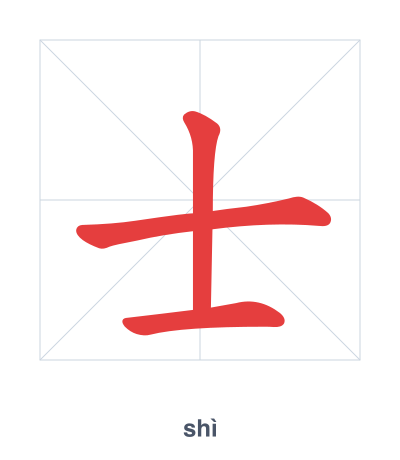
Open Hanzi Writer to see the animated stroke order and practice writing 士 with real-time feedback.
The character 士 (shì) is written with 3 strokes. Follow the standard Chinese stroke order: top to bottom, left to right, outside before inside. The radical 士 is one of its key components.
Practice the correct stroke order with the Hanzi Writer app to see animated stroke-by-stroke guidance with real-time feedback.
士 means soldier / scholar / gentleman.
As an HSK Level 4 character, 士 is an intermediate-level character.
The character 士 originated as a pictograph of a ceremonial axe or halberd, a weapon of authority wielded by warriors and officers in ancient China. This concrete image evolved to represent a 'soldier' or 'warrior,' and later broadened to include a 'scholar' or 'gentleman,' reflecting the ideal of a cultivated man who serves society. Its simple three-stroke form—a horizontal line, a vertical line, and another horizontal—suggests uprightness and strength.
💡 Memory Tip: Picture a soldier standing at attention, with the top horizontal line as his shoulders, the bottom as his feet, and the vertical as his straight spine.
她是一名护士。
tā shì yī míng hù shì
She is a nurse.
他正在读硕士。
tā zhèng zài dú shuò shì
He is studying for a master's degree.
士兵在操场集合。
shì bīng zài cāo chǎng jí hé
The soldiers gathered on the drill ground.
Open Hanzi Writer to see the animated stroke order and practice writing 士 with real-time feedback.
✨ Animated stroke order · Handwriting recognition · HSK-graded practice · Free to use
The character 士 is a simple radical by itself, consisting of two horizontal strokes and one vertical stroke crossing them. Originally, it depicted an axe or a tool of authority, which evolved to represent a person of rank or skill—hence meanings like soldier, scholar, or gentleman.