姨 (yí) means "aunt (mother's sister)" in Chinese. It has 9 strokes with the radical 女, and is HSK Level 4.
Rated 4/5 in difficulty (challenging).
Harder than 57% of HSK Level 4 characters.
Appears in 3+ common words including 阿姨 (ā yí), 姨妈 (yí mā), 小姨 (xiǎo yí).
Due to its 9 strokes, Hanzi Writer's error detection shows 姨 requires focused practice — most learners need 10+ attempts for consistent accuracy.
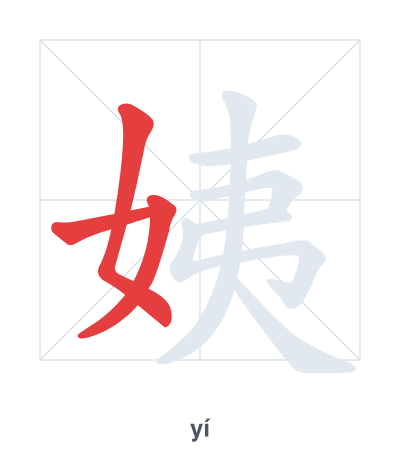
Open Hanzi Writer to see the animated stroke order and practice writing 姨 with real-time feedback.
The character 姨 (yí) is written with 9 strokes. Follow the standard Chinese stroke order: top to bottom, left to right, outside before inside. The radical 女 is one of its key components.
Practice the correct stroke order with the Hanzi Writer app to see animated stroke-by-stroke guidance with real-time feedback.
姨 means aunt (mother's sister).
As an HSK Level 4 character, 姨 is an intermediate-level character.
姨 is a compound character with the radical 女 (woman) on the left and the phonetic component 夷 (yí) on the right. The radical indicates a female relative, while 夷 provides the pronunciation. Thus, 姨 specifically denotes one's mother's sister, a maternal aunt.
💡 Memory Tip: Picture your aunt (女) as a fierce archer shooting arrows with a giant bow (夷).
阿姨,请喝茶。
ā yí qǐng hē chá
Auntie, please have some tea.
姨妈来看我。
yí mā lái kàn wǒ
My aunt came to see me.
我小姨是医生。
wǒ xiǎo yí shì yī shēng
My aunt is a doctor.
Open Hanzi Writer to see the animated stroke order and practice writing 姨 with real-time feedback.
✨ Animated stroke order · Handwriting recognition · HSK-graded practice · Free to use
姨 is a left-right structure. The left part is the radical 女 (woman), which shows the character relates to female family members. The right part 夷 (yí) gives the pronunciation and originally meant 'peaceful' or 'barbarian', but here it mainly functions as a phonetic component.