讦 (jié) means "to expose others' faults; to accuse" in Chinese. It has 5 strokes with the radical 讠.
Rated 2.7/5 in difficulty (moderate).
Appears in 3+ common words including 攻讦 (gōng jié), 讦发 (jié fā), 讦私 (jié sī).
Hanzi Writer's stroke validation shows learners typically need 5-8 attempts to write 讦 with correct proportion and order.
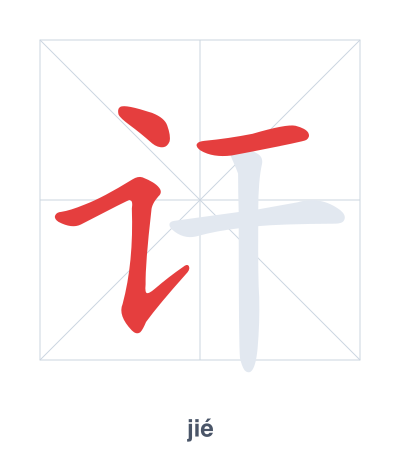
Open Hanzi Writer to see the animated stroke order and practice writing 讦 with real-time feedback.
The character 讦 (jié) is written with 5 strokes. Follow the standard Chinese stroke order: top to bottom, left to right, outside before inside. The radical 讠 is one of its key components.
Practice the correct stroke order with the Hanzi Writer app to see animated stroke-by-stroke guidance with real-time feedback.
讦 means to expose others' faults; to accuse.
讦 is a phono-semantic compound: the radical 讠 (speech) indicates it relates to words, while 干 (gān) contributes the sound and carries the sense of 'to offend' or 'to interfere,' together meaning to use speech to expose faults or accuse.
💡 Memory Tip: Imagine a speech bubble (讠) with a sharp spear (干) poking out, lunging forward to expose someone's secret faults.
他们互相攻讦。
tā men hù xiāng gōng jié
They are attacking each other verbally.
他讦发了那个人的秘密。
tā jié fā le nà ge rén de mì mì
He exposed that person's secret.
讦私是不礼貌的。
jié sī shì bù lǐ mào de
It is impolite to expose others' private matters.
Open Hanzi Writer to see the animated stroke order and practice writing 讦 with real-time feedback.
✨ Animated stroke order · Handwriting recognition · HSK-graded practice · Free to use
讦 is made of the radical 讠 (speech) on the left and 干 (shield) on the right. The speech radical shows it involves words, while 干 suggests striking or interfering, together meaning to verbally expose or accuse someone of faults.