称 (chèn/chēng/chèng) means "to weigh / to call" in Chinese. It has 10 strokes with the radical 禾, and is HSK Level 2.
Rated 3.7/5 in difficulty (challenging).
Harder than 89% of HSK Level 2 characters.
Appears in 5+ common words including 称呼 (chēng hū), 称赞 (chēng zàn), 称重 (chēng zhòng).
Due to its 10 strokes, Hanzi Writer's error detection shows 称 requires focused practice — most learners need 10+ attempts for consistent accuracy.
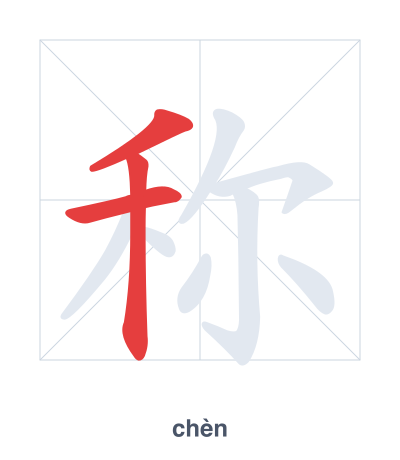
Open Hanzi Writer to see the animated stroke order and practice writing 称 with real-time feedback.
The character 称 (chèn/chēng/chèng) is written with 10 strokes. Follow the standard Chinese stroke order: top to bottom, left to right, outside before inside. The radical 禾 is one of its key components.
Practice the correct stroke order with the Hanzi Writer app to see animated stroke-by-stroke guidance with real-time feedback.
称 means to weigh / to call.
This is a polyphonic character with readings: chèn, chēng, chèng.
As an HSK Level 2 character, 称 is among the first characters beginners learn.
The simplified character 称 combines the radical 禾 (grain) with 尔, a simplified form of the phonetic component 爯. Originally in 稱, the right side depicted a hand lifting a weight, indicating the action of raising something to balance scales—hence 'to weigh.' Over time, the meaning extended to 'to call' (as in naming weight or calling out a name).
💡 Memory Tip: Imagine a grain stalk (禾) on a scale, and you (尔) call out its weight.
我该怎么称呼您?
wǒ gāi zěn me chēng hū nín
How should I address you?
老师称赞了他。
lǎo shī chēng zàn le tā
The teacher praised him.
请给这些苹果称重。
qǐng gěi zhè xiē píng guǒ chēng zhòng
Please weigh these apples.
这份工作让他很称心。
zhè fèn gōng zuò ràng tā hěn chèn xīn
This job is very satisfactory to him.
Open Hanzi Writer to see the animated stroke order and practice writing 称 with real-time feedback.
✨ Animated stroke order · Handwriting recognition · HSK-graded practice · Free to use
The left side is 禾 (grain/plant), which hints at the original meaning of weighing grain. The right side is 尔, which provides the sound chèn. Together, the character expresses both the action of weighing and the idea of calling someone by name.