骂 (mà) means "to scold; to curse; to abuse" in Chinese. It has 9 strokes with the radical 口, and is HSK Level 5.
Rated 4/5 in difficulty (challenging).
Harder than 61% of HSK Level 5 characters.
Appears in 3+ common words including 骂人 (mà rén), 挨骂 (ái mà), 责骂 (zé mà).
Due to its 9 strokes, Hanzi Writer's error detection shows 骂 requires focused practice — most learners need 10+ attempts for consistent accuracy.
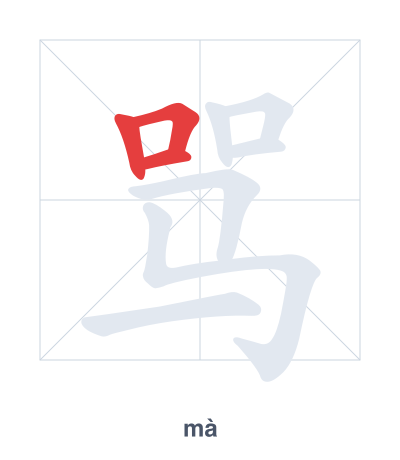
Open Hanzi Writer to see the animated stroke order and practice writing 骂 with real-time feedback.
The character 骂 (mà) is written with 9 strokes. Follow the standard Chinese stroke order: top to bottom, left to right, outside before inside. The radical 口 is one of its key components.
Practice the correct stroke order with the Hanzi Writer app to see animated stroke-by-stroke guidance with real-time feedback.
骂 means to scold; to curse; to abuse.
As an HSK Level 5 character, 骂 is an intermediate-level character.
This compound character combines the radical 口 (mouth) with 马 (horse, also a phonetic hint). The meaning 'to scold' or 'to curse' visually suggests a mouth making sounds like a horse's loud, forceful neighing, implying harsh verbal abuse.
💡 Memory Tip: Picture a horse (马) opening its mouth (口) to let out a loud, angry neigh that scolds everyone nearby.
随便骂人是不礼貌的。
suí biàn mà rén shì bù lǐ mào de
It is impolite to swear at people at will.
他因为迟到挨骂了。
tā yīn wèi chí dào ái mà le
He was scolded for being late.
老师没有责骂学生。
lǎo shī méi yǒu zé mà xué shēng
The teacher did not scold the students.
Open Hanzi Writer to see the animated stroke order and practice writing 骂 with real-time feedback.
✨ Animated stroke order · Handwriting recognition · HSK-graded practice · Free to use
骂 is made of two mouths (口口) stacked on top of a horse (马). The mouths represent speaking or shouting, and the horse component gives the sound "ma" — together they suggest using your mouth to shout harsh words, like scolding.