临 (lín) means "to face; to arrive; just before; to copy" in Chinese. It has 9 strokes with the radical 丨, and is HSK Level 4.
Rated 3.7/5 in difficulty (challenging).
Harder than 38% of HSK Level 4 characters.
Appears in 3+ common words including 临时 (lín shí), 欢迎光临 (huān yíng guāng lín), 临走 (lín zǒu).
Due to its 9 strokes, Hanzi Writer's error detection shows 临 requires focused practice — most learners need 10+ attempts for consistent accuracy.
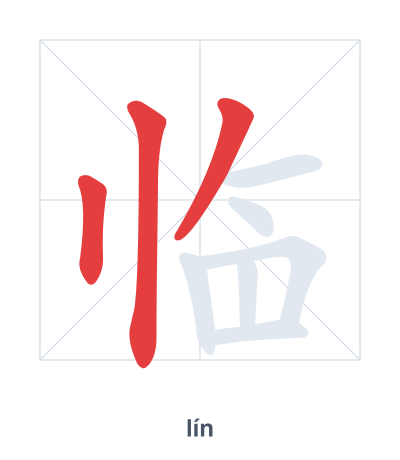
Open Hanzi Writer to see the animated stroke order and practice writing 临 with real-time feedback.
The character 临 (lín) is written with 9 strokes. Follow the standard Chinese stroke order: top to bottom, left to right, outside before inside. The radical 丨 is one of its key components.
Practice the correct stroke order with the Hanzi Writer app to see animated stroke-by-stroke guidance with real-time feedback.
临 means to face; to arrive; just before; to copy.
As an HSK Level 4 character, 临 is an intermediate-level character.
临 originally depicted a person (臣, now simplified to a vertical line 丨) bending down to inspect a row of vessels (品), conveying the sense of facing or approaching something. Over time, the meaning extended to 'to face', 'to arrive', and 'just before'.
💡 Memory Tip: Picture a person (the left vertical stroke) standing before three open mouths (品), arriving just in time to face a crowd.
他临时有事不能来了。
tā lín shí yǒu shì bù néng lái le
Something came up at the last minute, so he can't come.
欢迎光临我们的商店。
huān yíng guāng lín wǒ men de shāng diàn
Welcome to our store.
他临走前跟我打了个招呼。
tā lín zǒu qián gēn wǒ dǎ le gè zhāo hū
He said goodbye to me before he left.
Open Hanzi Writer to see the animated stroke order and practice writing 临 with real-time feedback.
✨ Animated stroke order · Handwriting recognition · HSK-graded practice · Free to use
The character 临 has a left radical 丨 (vertical line) and a right side that looks like stacked boxes or containers. The vertical line can represent a person standing, and the right side suggests something being faced or arrived at, reflecting meanings like 'to face' or 'to arrive'.