吝 (lìn) means "stingy / miserly" in Chinese. It has 7 strokes with the radical 口.
Rated 3.5/5 in difficulty (challenging).
Appears in 3+ common words including 吝啬 (lìn sè), 吝惜 (lìn xī), 不吝 (bù lìn).
Due to its 7 strokes, Hanzi Writer's error detection shows 吝 requires focused practice — most learners need 10+ attempts for consistent accuracy.
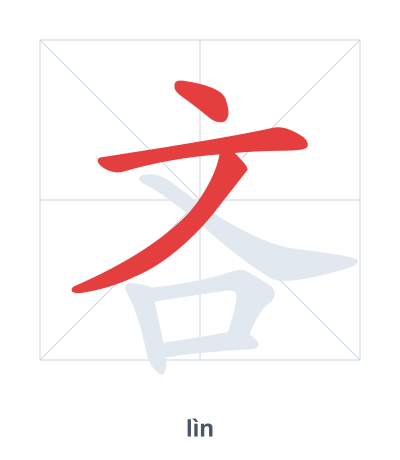
Open Hanzi Writer to see the animated stroke order and practice writing 吝 with real-time feedback.
The character 吝 (lìn) is written with 7 strokes. Follow the standard Chinese stroke order: top to bottom, left to right, outside before inside. The radical 口 is one of its key components.
Practice the correct stroke order with the Hanzi Writer app to see animated stroke-by-stroke guidance with real-time feedback.
吝 means stingy / miserly.
吝 is a compound of 口 (mouth) and 文 (pattern/decoration). The combination suggests a person who holds back even their words or decorations, reflecting a miserly nature that refuses to part with anything.
💡 Memory Tip: Imagine a miser's mouth (口) locked shut with a decorative pattern (文) because he's too stingy to even speak.
他买东西很吝啬。
tā mǎi dōng xī hěn lìn sè
He is very stingy when shopping.
他不吝惜力气。
tā bù lìn xī lì qì
He doesn't spare any effort.
请不吝赐教。
qǐng bù lìn cì jiào
Please do not hesitate to give your advice.
Open Hanzi Writer to see the animated stroke order and practice writing 吝 with real-time feedback.
✨ Animated stroke order · Handwriting recognition · HSK-graded practice · Free to use
吝 is a top-bottom structure: the top is 文 (wén, 'literature' or 'pattern'), and the bottom is 口 (kǒu, 'mouth'). The combination suggests someone who uses their mouth to speak in a patterned or calculating way, reflecting a stingy person who carefully guards their words or possessions.