乹 (gān/qián) means "heaven or dry (variant of 乾)" in Chinese. It has 9 strokes with the radical 乙.
Rated 3.7/5 in difficulty (challenging).
Appears in 3+ common words including 乹坤 (gān kūn), 乾隆 (qián lóng), 乹字 (gān zì).
Due to its 9 strokes, Hanzi Writer's error detection shows 乹 requires focused practice — most learners need 10+ attempts for consistent accuracy.
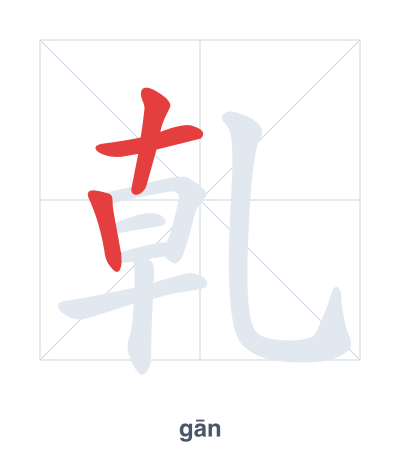
Open Hanzi Writer to see the animated stroke order and practice writing 乹 with real-time feedback.
The character 乹 (gān/qián) is written with 9 strokes. Follow the standard Chinese stroke order: top to bottom, left to right, outside before inside. The radical 乙 is one of its key components.
Practice the correct stroke order with the Hanzi Writer app to see animated stroke-by-stroke guidance with real-time feedback.
乹 means heaven or dry (variant of 乾).
This is a polyphonic character with readings: gān, qián.
| Character | 乹 |
| Pinyin | gān / qián (gan/qian) |
| Meaning | heaven or dry (variant of 乾) |
| Strokes | 9 |
| Radical | 乙 |
| Difficulty | 3.7/5 |
乹 is a variant of 乾, combining 干 (gān, meaning 'dry' or 'shield') as a phonetic and 乙 (yǐ, a curved hook representing the second heavenly stem) as a structural component. The original 乾 depicted the sun rising over a banner (倝) with 乙 indicating the end of the cycle, symbolizing both the dry, clear sky and the creative force of heaven. This variant simplifies the left side to 干 to directly evoke 'dryness' while retaining 乙 to connect to the heavenly stems.
💡 Memory Tip: Picture a dry (干) heaven where a curved hook (乙) snags the sun, keeping it high and arid.
乹坤代表天地。
gān kūn dài biǎo tiān dì
Qiankun represents heaven and earth.
乾隆是清朝皇帝。
qián lóng shì qīng cháo huáng dì
Qianlong was the Qing Dynasty emperor.
乹是干的异体字。
gān shì gàn de yì tǐ zì
'乹' is a variant form of '乾'.
Open Hanzi Writer to see the animated stroke order and practice writing 乹 with real-time feedback.
✨ Animated stroke order · Handwriting recognition · HSK-graded practice · Free to use
The left part is the radical 乙, which means 'second' or a hook shape. The right part is 干, meaning 'dry' or 'shield'. Together they form a variant of 乾, which carries the meanings of heaven or dry.