亭 (tíng) means "pavilion; kiosk" in Chinese. It has 9 strokes with the radical 亠, and is HSK Level 7.
Rated 3.7/5 in difficulty (challenging).
Harder than 22% of HSK Level 7 characters.
Appears in 3+ common words including 亭子 (tíng zi), 凉亭 (liáng tíng), 书报亭 (shū bào tíng).
Due to its 9 strokes, Hanzi Writer's error detection shows 亭 requires focused practice — most learners need 10+ attempts for consistent accuracy.
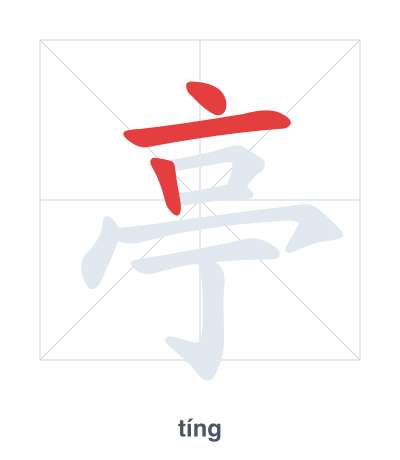
Open Hanzi Writer to see the animated stroke order and practice writing 亭 with real-time feedback.
The character 亭 (tíng) is written with 9 strokes. Follow the standard Chinese stroke order: top to bottom, left to right, outside before inside. The radical 亠 is one of its key components.
Practice the correct stroke order with the Hanzi Writer app to see animated stroke-by-stroke guidance with real-time feedback.
亭 means pavilion; kiosk.
As an HSK Level 7 character, 亭 is an intermediate-level character.
Ancient script 亭 depicted a tall, pointed-roof structure used as a roadside rest stop. The modern form combines 亠 (roof), 口 (platform), and 丁 (nail/post), symbolizing a sturdy shelter on a raised base.
💡 Memory Tip: Imagine a tiny roof (亠) over a mouth (口) that shouts 'Ting!' to a nail (丁) holding up a pavilion.
公园里有一个小亭子。
gōng yuán lǐ yǒu yí gè xiǎo tíng zi
There is a small pavilion in the park.
我们在凉亭里休息吧。
wǒ men zài liáng tíng lǐ xiū xī ba
Let's rest in the pavilion.
我在书报亭买了一份报纸。
wǒ zài shū bào tíng mǎi le yī fèn bào zhǐ
I bought a newspaper at the newsstand.
Open Hanzi Writer to see the animated stroke order and practice writing 亭 with real-time feedback.
✨ Animated stroke order · Handwriting recognition · HSK-graded practice · Free to use
The character 亭 consists of a top radical 亠 (lid or roof) and a lower part that resembles a pillar or structure. The roof-like top suggests a covered building, which matches the meaning of a pavilion or kiosk. The overall shape imitates a small, open-sided shelter.