人 (rén) means "person; human; people" in Chinese. It has 2 strokes with the radical 人, and is HSK Level 1.
Rated 1.4/5 in difficulty (beginner-friendly).
Harder than 3% of HSK Level 1 characters.
Appears in 3+ common words including 人们 (rén men), 好人 (hǎo rén), 别人 (bié rén).
In the Hanzi Writer app, most learners master 人 within 3 practice attempts using stroke-by-stroke animation.
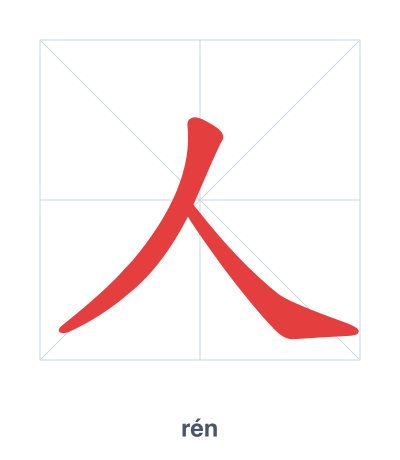
Open Hanzi Writer to see the animated stroke order and practice writing 人 with real-time feedback.
The character 人 (rén) is written with 2 strokes. Follow the standard Chinese stroke order: top to bottom, left to right, outside before inside. The radical 人 is one of its key components.
Practice the correct stroke order with the Hanzi Writer app to see animated stroke-by-stroke guidance with real-time feedback.
人 means person; human; people.
As an HSK Level 1 character, 人 is among the first characters beginners learn.
人 is a pictograph depicting a person in profile, with the left stroke representing the arm and body, and the right stroke representing the leg. In ancient oracle bone script, it looked like a simple figure of a standing person, emphasizing the upright posture of a human.
💡 Memory Tip: Imagine the two strokes as a person standing with legs apart, arms at their sides, forming the silhouette of a human.
人们都喜欢喝茶。
rén men dōu xǐ huān hē chá
Everyone likes drinking tea.
他是一个好人。
tā shì yí gè hǎo rén
He is a good person.
不要告诉别人。
bú yào gào sù bié rén
Don't tell others.
Open Hanzi Writer to see the animated stroke order and practice writing 人 with real-time feedback.
✨ Animated stroke order · Handwriting recognition · HSK-graded practice · Free to use
人 is a pictograph that originally depicted a standing person with two legs. The two strokes represent the body and legs of a human figure, directly symbolizing a person. This simple shape forms the basis for many related characters.