亲 (qīn/qìng) means "parent; relative; close; dear" in Chinese. It has 9 strokes with the radical 立, and is HSK Level 3.
Rated 4/5 in difficulty (challenging).
Harder than 59% of HSK Level 3 characters.
Appears in 3+ common words including 亲人 (qīn rén), 亲近 (qīn jìn), 亲家 (qìng jia).
Due to its 9 strokes, Hanzi Writer's error detection shows 亲 requires focused practice — most learners need 10+ attempts for consistent accuracy.
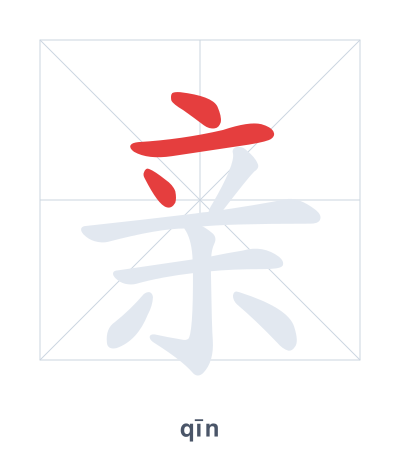
Open Hanzi Writer to see the animated stroke order and practice writing 亲 with real-time feedback.
The character 亲 (qīn/qìng) is written with 9 strokes. Follow the standard Chinese stroke order: top to bottom, left to right, outside before inside. The radical 立 is one of its key components.
Practice the correct stroke order with the Hanzi Writer app to see animated stroke-by-stroke guidance with real-time feedback.
亲 means parent; relative; close; dear.
This is a polyphonic character with readings: qīn, qìng.
As an HSK Level 3 character, 亲 is an intermediate-level character.
Originally part of the traditional character 親, which combined a phonetic component (亲) with 見 (see) to mean 'to see closely' or 'close relation.' The simplified form 亲 uses 立 (stand) over 木 (tree), suggesting a parent standing by a tree, symbolizing a close or intimate bond.
💡 Memory Tip: Picture a parent standing (立) under a tree (木) to be close to their child playing in the branches.
无论走多远,家里的亲人永远是你最坚强的后盾。
wú lùn zǒu duō yuǎn jiā lǐ de qīn rén yǒng yuǎn shì nǐ zuì jiān qiáng de hòu dùn
No matter how far you go, your family will always be your strongest support.
这只小猫性格温顺,非常喜欢和人亲近。
zhè zhǐ xiǎo māo xìng gé wēn shùn fēi cháng xǐ huān hé rén qīn jìn
This kitten has a gentle temperament and loves being close to people.
我父母和他的父母是相处得非常融洽的亲家。
wǒ fù mǔ hé tā de fù mǔ shì xiāng chǔ dé fēi cháng róng qià de qìng jia
My parents and his parents are in-laws who get along very harmoniously.
Open Hanzi Writer to see the animated stroke order and practice writing 亲 with real-time feedback.
✨ Animated stroke order · Handwriting recognition · HSK-graded practice · Free to use
亲 is composed of the top part 立 (meaning 'to stand') and the bottom part 木 (meaning 'tree' or 'wood'). Together, they suggest a person standing close to a tree, representing the idea of closeness or intimacy. This structure visually reinforces the character's meanings of 'close', 'dear', or 'relative'.