举 (jǔ) means "To lift, raise, or act." in Chinese. It has 9 strokes with the radical 丶, and is HSK Level 2.
Rated 2.8/5 in difficulty (moderate).
Harder than 32% of HSK Level 2 characters.
Appears in 3+ common words including 举手 (jǔ shǒu), 举例 (jǔ lì), 举办 (jǔ bàn).
Hanzi Writer's stroke validation shows learners typically need 5-8 attempts to write 举 with correct proportion and order.
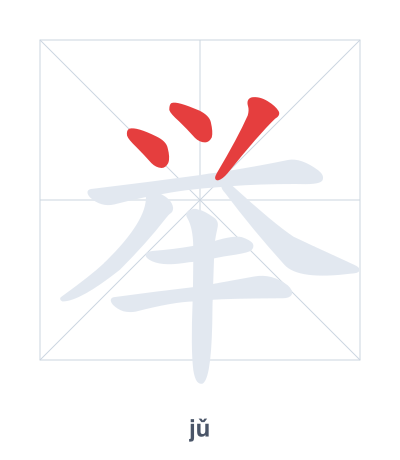
Open Hanzi Writer to see the animated stroke order and practice writing 举 with real-time feedback.
The character 举 (jǔ) is written with 9 strokes. Follow the standard Chinese stroke order: top to bottom, left to right, outside before inside. The radical 丶 is one of its key components.
Practice the correct stroke order with the Hanzi Writer app to see animated stroke-by-stroke guidance with real-time feedback.
举 means To lift, raise, or act..
As an HSK Level 2 character, 举 is among the first characters beginners learn.
In its traditional form 舉, the character shows hands (舁) jointly lifting an object (与). The simplified 举 combines 兴 (evoking the idea of rising or flourishing) with a hand-like shape below, representing the action of raising something with effort.
💡 Memory Tip: Picture a hand (the bottom strokes) lifting a platform with three stacked items (the top part 兴) — that's 举, to lift.
请大家举手。
qǐng dà jiā jǔ shǒu
Everyone, please raise your hands.
如果你不理解,我可以再为你举例说明。
rú guǒ nǐ bù lǐ jiě , wǒ kě yǐ zài wèi nǐ jǔ lì shuō míng 。
If you don't understand, I can give you more examples.
学校举办了一场运动会。
xué xiào jǔ bàn le yī cháng yùn dòng huì 。
The school held a sports meet.
Open Hanzi Writer to see the animated stroke order and practice writing 举 with real-time feedback.
✨ Animated stroke order · Handwriting recognition · HSK-graded practice · Free to use
举 is composed of three parts: the radical 丶 (dot) at the top, the middle part 兴 (which originally meant 'to lift together'), and the bottom 手 (hand). The combined structure suggests using your hand to lift something up, which connects to its meaning 'to lift' or 'to raise'.