避 (bì) means "to avoid / to shun / to escape" in Chinese. It has 16 strokes with the radical 辶, and is HSK Level 4.
Rated 4.2/5 in difficulty (advanced).
Harder than 97% of HSK Level 4 characters.
Appears in 3+ common words including 避免 (bì miǎn), 避暑 (bì shǔ), 逃避 (táo bì).
Due to its 16 strokes, Hanzi Writer's error detection shows 避 requires focused practice — most learners need 10+ attempts for consistent accuracy.
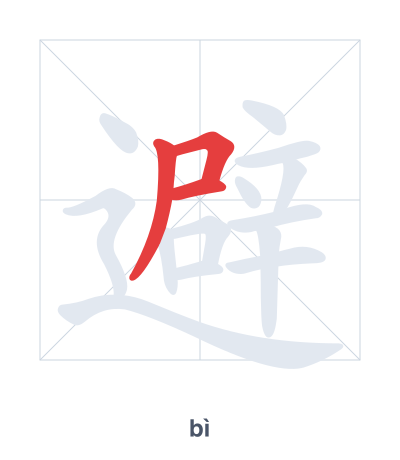
Open Hanzi Writer to see the animated stroke order and practice writing 避 with real-time feedback.
The character 避 (bì) is written with 16 strokes. Follow the standard Chinese stroke order: top to bottom, left to right, outside before inside. The radical 辶 is one of its key components.
Practice the correct stroke order with the Hanzi Writer app to see animated stroke-by-stroke guidance with real-time feedback.
避 means to avoid / to shun / to escape.
As an HSK Level 4 character, 避 is an intermediate-level character.
避 combines the radical 辶 (walk) with 辟 (pì, meaning to avoid or evade), originally depicting a person walking away to escape something dangerous or unpleasant. The component 辟 itself derives from a kneeling person and a knife, symbolizing punishment or avoidance of harm.
💡 Memory Tip: Picture a criminal (辟) running away (辶) to avoid being caught by the police.
这样做可以避免错误。
zhè yàng zuò kě yǐ bì miǎn cuò wù
Doing this can avoid mistakes.
我们去山上避暑吧。
wǒ men qù shān shàng bì shǔ ba
Let's go to the mountains to escape the heat.
你不能逃避责任。
nǐ bù néng táo bì zé rèn
You cannot evade responsibility.
Open Hanzi Writer to see the animated stroke order and practice writing 避 with real-time feedback.
✨ Animated stroke order · Handwriting recognition · HSK-graded practice · Free to use
避 consists of the radical 辶 (walk) on the left, suggesting movement, and the element 辟 (pì) on the right, which acts as a phonetic component and also carries the idea of 'avoiding' or 'shunning'. Together they create the meaning of moving away to avoid something.