逃 (táo) means "to escape; to run away" in Chinese. It has 9 strokes with the radical 辶, and is HSK Level 5.
Rated 4/5 in difficulty (challenging).
Harder than 60% of HSK Level 5 characters.
Appears in 3+ common words including 逃跑 (táo pǎo), 逃避 (táo bì), 逃课 (táo kè).
Due to its 9 strokes, Hanzi Writer's error detection shows 逃 requires focused practice — most learners need 10+ attempts for consistent accuracy.
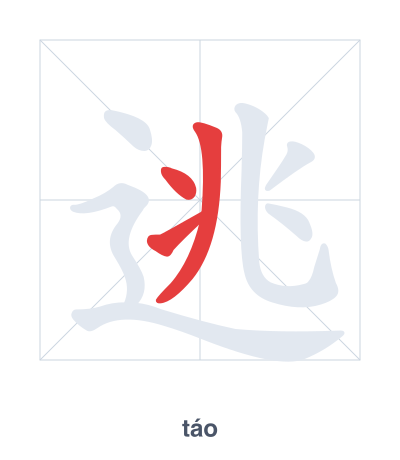
Open Hanzi Writer to see the animated stroke order and practice writing 逃 with real-time feedback.
The character 逃 (táo) is written with 9 strokes. Follow the standard Chinese stroke order: top to bottom, left to right, outside before inside. The radical 辶 is one of its key components.
Practice the correct stroke order with the Hanzi Writer app to see animated stroke-by-stroke guidance with real-time feedback.
逃 means to escape; to run away.
As an HSK Level 5 character, 逃 is an intermediate-level character.
逃 combines the radical 辶 (walk/action) with 兆 (zhào, meaning 'omen' or 'sign'), suggesting the idea of walking away from an ominous sign or danger. The character thus visually depicts fleeing from a bad omen.
💡 Memory Tip: Picture a person (辶) sprinting away from a giant fortune cookie (兆) that just cracked open to reveal a terrible prophecy.
兔子飞快地逃跑了。
tù zi fēi kuài dì táo pǎo le
The rabbit ran away quickly.
不要逃避你的责任。
bú yào táo bì nǐ de zé rèn
Don't evade your responsibility.
好学生不应该逃课。
hào xué shēng bù yīng gāi táo kè
Good students shouldn't skip classes.
Open Hanzi Writer to see the animated stroke order and practice writing 逃 with real-time feedback.
✨ Animated stroke order · Handwriting recognition · HSK-graded practice · Free to use
逃 is made of the radical 辶 (walk or movement) on the left and the component 兆 (which originally meant a sign or omen) on the right. The 辶 shows that the meaning involves moving, while 兆 hints at the sound táo and also suggests fleeing from a bad omen. Together they create the idea of running away from something.