迈 (mài) means "to step; to stride" in Chinese. It has 6 strokes with the radical 辶, and is HSK Level 7.
Rated 3.2/5 in difficulty (challenging).
Harder than 12% of HSK Level 7 characters.
Appears in 3+ common words including 迈步 (mài bù), 年迈 (nián mài), 豪迈 (háo mài).
Due to its 6 strokes, Hanzi Writer's error detection shows 迈 requires focused practice — most learners need 10+ attempts for consistent accuracy.
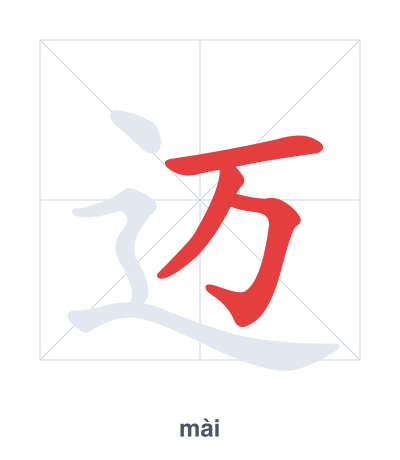
Open Hanzi Writer to see the animated stroke order and practice writing 迈 with real-time feedback.
The character 迈 (mài) is written with 6 strokes. Follow the standard Chinese stroke order: top to bottom, left to right, outside before inside. The radical 辶 is one of its key components.
Practice the correct stroke order with the Hanzi Writer app to see animated stroke-by-stroke guidance with real-time feedback.
迈 means to step; to stride.
As an HSK Level 7 character, 迈 is an intermediate-level character.
迈 is a phono-semantic compound. The radical 辶 (walk) indicates movement, while the right side 万 (wàn, meaning 'ten thousand') provides the pronunciation. Together, they suggest taking many steps—hence 'to stride' or 'to step forward.'
💡 Memory Tip: Picture yourself taking a giant stride (辶) over ten thousand (万) obstacles to reach your goal.
他迈步走向教室。
tā mài bù zǒu xiàng jiào shì
He stepped toward the classroom.
他的祖父已经年迈了。
tā de zǔ fù yǐ jīng nián mài le
His grandfather is already elderly.
他的歌声很豪迈。
tā de gē shēng hěn háo mài
His singing is very bold and heroic.
Open Hanzi Writer to see the animated stroke order and practice writing 迈 with real-time feedback.
✨ Animated stroke order · Handwriting recognition · HSK-graded practice · Free to use
迈 is made of the radical 辶, which means "walk" or "movement," and the component 万 (wàn, ten thousand) which provides the pronunciation "mài." The radical directly connects to the meaning "to step" or "to stride." Together they suggest a large step covering a great distance.