劓 (yì) means "cutting off the nose (ancient punishment)" in Chinese. It has 16 strokes with the radical 刂.
Rated 3.9/5 in difficulty (challenging).
Appears in 3+ common words including 劓刑 (yì xíng), 劓灭 (yì miè), 劓殄 (yì tiǎn).
Due to its 16 strokes, Hanzi Writer's error detection shows 劓 requires focused practice — most learners need 10+ attempts for consistent accuracy.
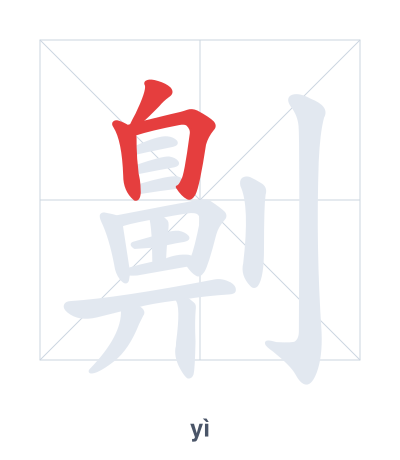
Open Hanzi Writer to see the animated stroke order and practice writing 劓 with real-time feedback.
The character 劓 (yì) is written with 16 strokes. Follow the standard Chinese stroke order: top to bottom, left to right, outside before inside. The radical 刂 is one of its key components.
Practice the correct stroke order with the Hanzi Writer app to see animated stroke-by-stroke guidance with real-time feedback.
劓 means cutting off the nose (ancient punishment).
The character 劓 combines 鼻 (nose) and 刂 (knife), visually representing the act of cutting off the nose as a punishment in ancient China. The left component 鼻 depicts the nose, while the right radical 刂 indicates the cutting action.
💡 Memory Tip: Picture a knife (刂) slicing off a nose (鼻) – a brutal image that sticks with the ancient penalty of nose-cutting.
劓刑是古代的刑罚。
yì xíng shì gǔ dài de xíng fá
Cutting off the nose was an ancient punishment.
这种文化被劓灭了。
zhè zhǒng wén huà bèi yì miè le
This culture was wiped out.
这种行为会劓殄天物。
zhè zhǒng xíng wéi huì yì tiǎn tiān wù
This behavior is a reckless waste of natural resources.
Open Hanzi Writer to see the animated stroke order and practice writing 劓 with real-time feedback.
✨ Animated stroke order · Handwriting recognition · HSK-graded practice · Free to use
The left side 鼻 means "nose," and the right side 刂 is a knife radical. Together, they literally show a knife cutting the nose, which directly describes the ancient punishment of cutting off the nose.