迂 (yū) means "circuitous; pedantic" in Chinese. It has 6 strokes with the radical 辶.
Rated 3.2/5 in difficulty (challenging).
Appears in 3+ common words including 迂回 (yū huí), 迂腐 (yū fǔ), 迂阔 (yū kuò).
Due to its 6 strokes, Hanzi Writer's error detection shows 迂 requires focused practice — most learners need 10+ attempts for consistent accuracy.
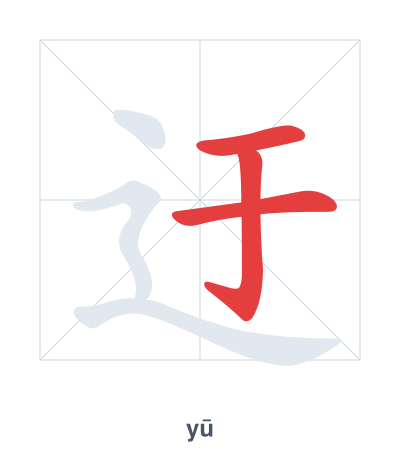
Open Hanzi Writer to see the animated stroke order and practice writing 迂 with real-time feedback.
The character 迂 (yū) is written with 6 strokes. Follow the standard Chinese stroke order: top to bottom, left to right, outside before inside. The radical 辶 is one of its key components.
Practice the correct stroke order with the Hanzi Writer app to see animated stroke-by-stroke guidance with real-time feedback.
迂 means circuitous; pedantic.
迂 is a phono-semantic compound: the radical 辶 (walk) indicates movement, while 于 (yú) provides phonetic and a hint of 'going astray' — together they depict a path that bends and twists, giving the meanings 'circuitous' and then 'pedantic' (someone who takes a roundabout way in thought).
💡 Memory Tip: Picture a pedantic professor (于) walking in a long, winding detour (辶) because he insists on taking the most complicated route to class.
这里的山路很迂回。
zhè lǐ de shān lù hěn yū huí
The mountain roads here are very winding.
他的想法太迂腐了。
tā de xiǎng fǎ tài yū fǔ le
His ideas are too pedantic.
这个计划太迂阔了。
zhè ge jì huà tài yū kuò le
This plan is too impractical.
Open Hanzi Writer to see the animated stroke order and practice writing 迂 with real-time feedback.
✨ Animated stroke order · Handwriting recognition · HSK-graded practice · Free to use
迂 combines the radical 辶 (walk) with 于 (yú), which gives a clue to its pronunciation. The radical 辶 suggests movement, but the character means 'circuitous' or 'roundabout,' reflecting a path that is not direct. In a broader sense, 'pedantic' describes someone who takes a roundabout, overly detailed approach to thinking.