噪 (zào) means "noise or clamor" in Chinese. It has 16 strokes with the radical 口, and is HSK Level 7.
Rated 4.2/5 in difficulty (advanced).
Harder than 49% of HSK Level 7 characters.
Appears in 3+ common words including 噪音 (zào yīn), 吵噪 (chǎo zào), 噪杂 (zào zá).
Due to its 16 strokes, Hanzi Writer's error detection shows 噪 requires focused practice — most learners need 10+ attempts for consistent accuracy.
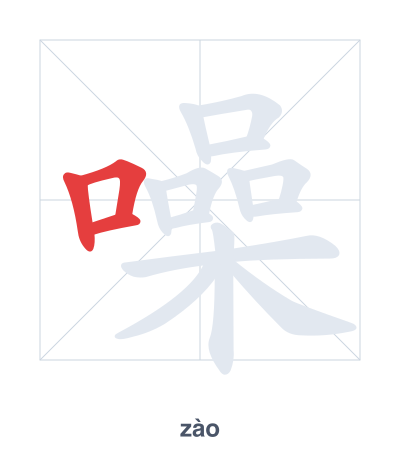
Open Hanzi Writer to see the animated stroke order and practice writing 噪 with real-time feedback.
The character 噪 (zào) is written with 16 strokes. Follow the standard Chinese stroke order: top to bottom, left to right, outside before inside. The radical 口 is one of its key components.
Practice the correct stroke order with the Hanzi Writer app to see animated stroke-by-stroke guidance with real-time feedback.
噪 means noise or clamor.
As an HSK Level 7 character, 噪 is an intermediate-level character.
噪 is a compound character with the radical 口 (mouth) and the phonetic component 喿, which itself consists of three 口 (mouths) above 木 (tree). The image of multiple mouths around a tree suggests birds or people chattering loudly, creating a clamor.
💡 Memory Tip: Imagine three birds (three 口) on a tree (木) all chirping at once, and you cover your ears with another mouth (口 radical) because of the terrible noise.
外面的噪音很大。
wài miàn de zào yīn hěn dà
The noise outside is very loud.
教室里很吵噪。
jiào shì lǐ hěn chǎo zào
The classroom is very noisy.
这里的环境很噪杂。
zhè lǐ de huán jìng hěn zào zá
The environment here is noisy and chaotic.
Open Hanzi Writer to see the animated stroke order and practice writing 噪 with real-time feedback.
✨ Animated stroke order · Handwriting recognition · HSK-graded practice · Free to use
The character 噪 has the radical 口 (mouth) on the left, representing speech or sound. On the right is 喿, which itself contains three 口 (mouths) above a 木 (tree), suggesting many mouths squawking in a tree. This combination of many mouths producing sound directly conveys the idea of "noise" or "clamor."