迁 (qiān) means "to move; to shift" in Chinese. It has 6 strokes with the radical 辶, and is HSK Level 6.
Rated 3.2/5 in difficulty (challenging).
Harder than 14% of HSK Level 6 characters.
Appears in 3+ common words including 搬迁 (bān qiān), 变迁 (biàn qiān), 迁就 (qiān jiù).
Due to its 6 strokes, Hanzi Writer's error detection shows 迁 requires focused practice — most learners need 10+ attempts for consistent accuracy.
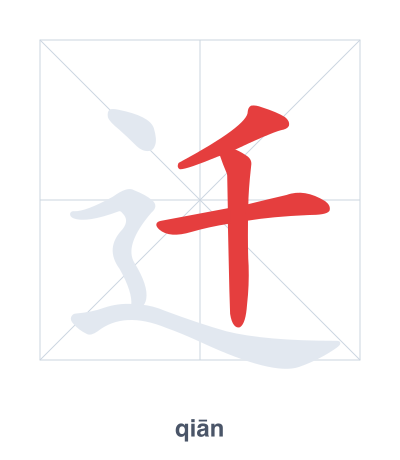
Open Hanzi Writer to see the animated stroke order and practice writing 迁 with real-time feedback.
The character 迁 (qiān) is written with 6 strokes. Follow the standard Chinese stroke order: top to bottom, left to right, outside before inside. The radical 辶 is one of its key components.
Practice the correct stroke order with the Hanzi Writer app to see animated stroke-by-stroke guidance with real-time feedback.
迁 means to move; to shift.
As an HSK Level 6 character, 迁 is an intermediate-level character.
The character 迁 combines the radical 辶 (walking/movement) with the phonetic component 千 (qiān, meaning thousand). The radical indicates the action of moving or shifting from one place to another, while 千 provides the pronunciation. In its traditional form 遷, it originally depicted a person moving, but the modern simplified version uses 千 as a phonetic element.
💡 Memory Tip: Imagine a thousand (千) steps along a path (辶) as you move to a new home.
这家店要搬迁了。
zhè jiā diàn yào bān qiān le
This shop is going to relocate.
时代在不断变迁。
shí dài zài bù duàn biàn qiān
Times are constantly changing.
你不要总是迁就他。
nǐ bú yào zǒng shì qiān jiù tā
Don't always yield to him.
Open Hanzi Writer to see the animated stroke order and practice writing 迁 with real-time feedback.
✨ Animated stroke order · Handwriting recognition · HSK-graded practice · Free to use
迁 is made of the radical 辶 (walk) on the left and 千 (thousand) on the right. The radical 辶 connects it to movement or travel, while 千 can suggest a long distance, together implying 'to move or shift to another place.'