边 (biān) means "Side / Edge / Border" in Chinese. It has 5 strokes with the radical 辶, and is HSK Level 1.
Rated 2.4/5 in difficulty (moderate).
Harder than 34% of HSK Level 1 characters.
Appears in 3+ common words including 旁边 (páng biān), 左边 (zuǒ biān), 海边 (hǎi biān).
Hanzi Writer's stroke validation shows learners typically need 5-8 attempts to write 边 with correct proportion and order.
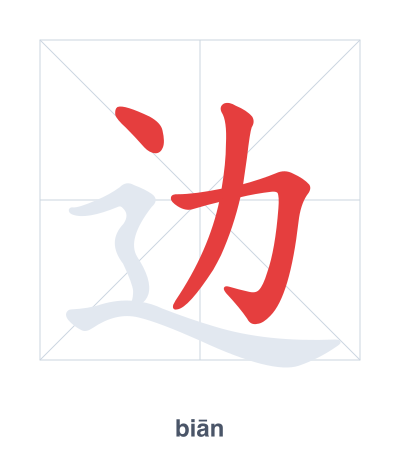
Open Hanzi Writer to see the animated stroke order and practice writing 边 with real-time feedback.
The character 边 (biān) is written with 5 strokes. Follow the standard Chinese stroke order: top to bottom, left to right, outside before inside. The radical 辶 is one of its key components.
Practice the correct stroke order with the Hanzi Writer app to see animated stroke-by-stroke guidance with real-time feedback.
边 means Side / Edge / Border.
As an HSK Level 1 character, 边 is among the first characters beginners learn.
The simplified character 边 combines the radical 辶 (walking) with the phonetic component 力 (strength). Its original meaning 'border' or 'edge' came from the idea of traveling to the farthest boundary, with the walking radical emphasizing movement toward a limit.
💡 Memory Tip: Picture a strong person (力) walking (辶) with effort to reach the very edge of a cliff.
学校就在书店旁边。
xué xiào jiù zài shū diàn páng biān
The school is right next to the bookstore.
你的左边有一本书。
nǐ de zuǒ biān yǒu yī běn shū
There is a book to your left.
我们夏天去海边玩。
wǒ men xià tiān qù hǎi biān wán
We go to the seaside in the summer.
Open Hanzi Writer to see the animated stroke order and practice writing 边 with real-time feedback.
✨ Animated stroke order · Handwriting recognition · HSK-graded practice · Free to use
边 combines the radical 辶 (walking) on the left and the component 力 (strength/power) on the right. The radical suggests movement along a path, while 力 hints at a forceful boundary or limit, together creating the idea of a 'side' or 'edge'.