噤 (jìn) means "to keep silent" in Chinese. It has 16 strokes with the radical 口.
Rated 4.2/5 in difficulty (advanced).
Appears in 3+ common words including 噤声 (jìn shēng), 噤口 (jìn kǒu), 打寒噤 (dǎ hán jìn).
Due to its 16 strokes, Hanzi Writer's error detection shows 噤 requires focused practice — most learners need 10+ attempts for consistent accuracy.
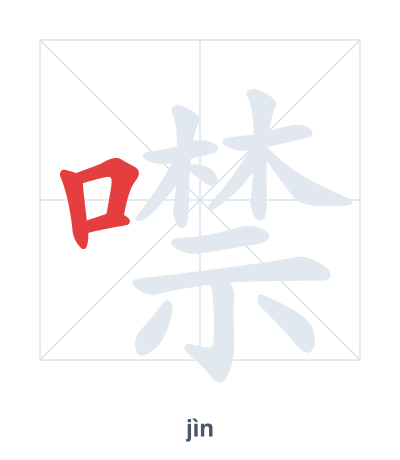
Open Hanzi Writer to see the animated stroke order and practice writing 噤 with real-time feedback.
The character 噤 (jìn) is written with 16 strokes. Follow the standard Chinese stroke order: top to bottom, left to right, outside before inside. The radical 口 is one of its key components.
Practice the correct stroke order with the Hanzi Writer app to see animated stroke-by-stroke guidance with real-time feedback.
噤 means to keep silent.
噤 combines the mouth radical (口) with 禁 (jìn, 'to forbid'), which itself depicts a forest (林) over an altar (示) as a taboo sign. Together, they mean 'mouth forbidden'—hence, keeping silent.
💡 Memory Tip: Imagine a giant mouth (口) taped shut with a 'NO TALKING' sign that looks like the complex 禁 on its right side.
大家请保持噤声。
dà jiā qǐng bǎo chí jìn shēng
Everyone, please keep quiet.
他对此事噤口不言。
tā duì cǐ shì jìn kǒu bù yán
He kept silent about this matter.
他冷得打了一个寒噤。
tā lěng dé dǎ le yí gè hán jìn
He shivered with cold.
Open Hanzi Writer to see the animated stroke order and practice writing 噤 with real-time feedback.
✨ Animated stroke order · Handwriting recognition · HSK-graded practice · Free to use
噤 is composed of the radical 口 (mouth) on the left and 禁 (jìn, to forbid) on the right. The combination suggests a mouth that is forbidden from making sound, which leads to the meaning 'to keep silent.'