器 (qì) means "device or vessel" in Chinese. It has 16 strokes with the radical 口, and is HSK Level 3.
Rated 4.2/5 in difficulty (advanced).
Harder than 71% of HSK Level 3 characters.
Appears in 3+ common words including 机器 (jī qì), 乐器 (yuè qì), 电器 (diàn qì).
Due to its 16 strokes, Hanzi Writer's error detection shows 器 requires focused practice — most learners need 10+ attempts for consistent accuracy.
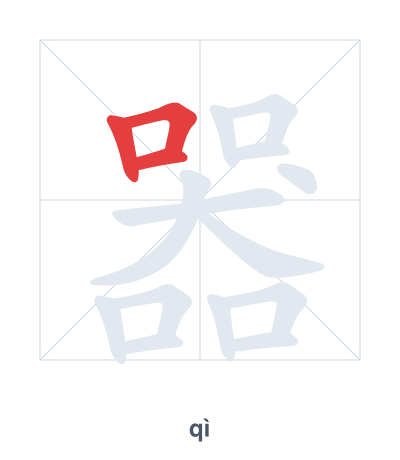
Open Hanzi Writer to see the animated stroke order and practice writing 器 with real-time feedback.
The character 器 (qì) is written with 16 strokes. Follow the standard Chinese stroke order: top to bottom, left to right, outside before inside. The radical 口 is one of its key components.
Practice the correct stroke order with the Hanzi Writer app to see animated stroke-by-stroke guidance with real-time feedback.
器 means device or vessel.
As an HSK Level 3 character, 器 is an intermediate-level character.
This character is composed of four 口 (mouths or vessels) arranged around a central 犬 (dog), originally depicting a dog guarding multiple containers, thus conveying the idea of a 'device' or 'vessel'.
💡 Memory Tip: Imagine a dog (犬) standing watch over four containers (口) — each container holds a different device.
这台机器坏了。
zhè tái jī qì huài le
This machine is broken.
你会弹什么乐器?
nǐ huì dàn shén me yuè qì
What instrument can you play?
家里有很多电器。
jiā lǐ yǒu hěn duō diàn qì
There are many electrical appliances at home.
Open Hanzi Writer to see the animated stroke order and practice writing 器 with real-time feedback.
✨ Animated stroke order · Handwriting recognition · HSK-graded practice · Free to use
器 is made of four 口 (kǒu, mouth) arranged around a central 犬 (quǎn, dog). The mouths represent containers or openings, and the dog in the middle suggests a guard or inner part, together conveying the idea of a vessel or device that holds something.