遭 (zāo) means "To encounter; to suffer." in Chinese. It has 14 strokes with the radical 辶, and is HSK Level 6.
Rated 4.2/5 in difficulty (advanced).
Harder than 95% of HSK Level 6 characters.
Appears in 3+ common words including 遭遇 (zāo yù), 遭受 (zāo shòu), 遭殃 (zāo yāng).
Due to its 14 strokes, Hanzi Writer's error detection shows 遭 requires focused practice — most learners need 10+ attempts for consistent accuracy.
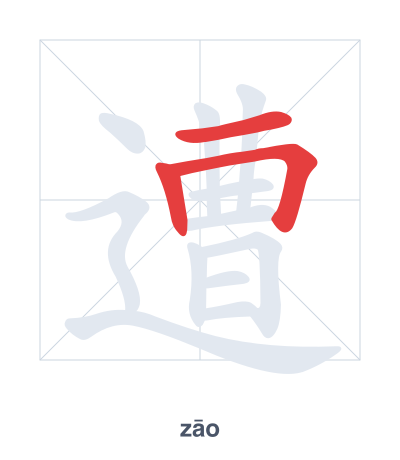
Open Hanzi Writer to see the animated stroke order and practice writing 遭 with real-time feedback.
The character 遭 (zāo) is written with 14 strokes. Follow the standard Chinese stroke order: top to bottom, left to right, outside before inside. The radical 辶 is one of its key components.
Practice the correct stroke order with the Hanzi Writer app to see animated stroke-by-stroke guidance with real-time feedback.
遭 means To encounter; to suffer..
As an HSK Level 6 character, 遭 is an intermediate-level character.
遭 is a compound character with the radical 辶 (walking/action) indicating movement, and 曹 (cáo) providing pronunciation. Originally meaning 'to meet' or 'encounter', it often implies an unfortunate meeting, like encountering trouble. The 曹 component, which historically depicted a group of people or a court, suggests coming upon a crowd or situation unexpectedly.
💡 Memory Tip: Picture someone walking (辶) through a field of cacti (曹 looks like many pointy shapes) and suffering a painful encounter.
他遭遇了困难。
tā zāo yù le kùn nán
He encountered difficulties.
公司遭受了损失。
gōng sī zāo shòu le sǔn shī
The company suffered losses.
这里的庄稼遭殃了。
zhè lǐ de zhuāng jià zāo yāng le
The crops here have suffered damage.
Open Hanzi Writer to see the animated stroke order and practice writing 遭 with real-time feedback.
✨ Animated stroke order · Handwriting recognition · HSK-graded practice · Free to use
遭 is made of two parts: the radical 辶 (walk) on the outside and the phonetic component 曹 (cáo) on the inside. The 辶 indicates movement or travel, while 曹 provides sound. Together they suggest "walking into" something, leading to the meaning of encountering or suffering an event, often unpleasant.