噩 (è) means "shocking or bad" in Chinese. It has 16 strokes with the radical 口.
Rated 4.2/5 in difficulty (advanced).
Appears in 3+ common words including 噩梦 (è mèng), 噩耗 (è hào), 噩运 (è yùn).
Due to its 16 strokes, Hanzi Writer's error detection shows 噩 requires focused practice — most learners need 10+ attempts for consistent accuracy.
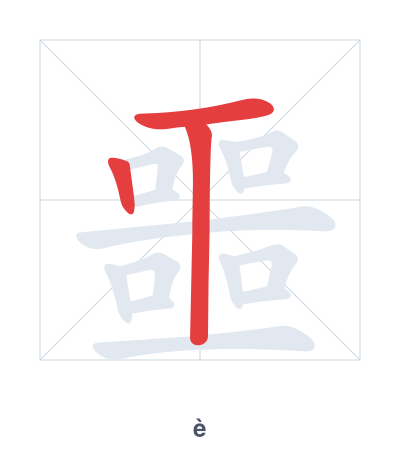
Open Hanzi Writer to see the animated stroke order and practice writing 噩 with real-time feedback.
The character 噩 (è) is written with 16 strokes. Follow the standard Chinese stroke order: top to bottom, left to right, outside before inside. The radical 口 is one of its key components.
Practice the correct stroke order with the Hanzi Writer app to see animated stroke-by-stroke guidance with real-time feedback.
噩 means shocking or bad.
噩 is a compound of four 口 (mouths) around a central 王 (king), originally depicting many mouths shouting in alarm, symbolizing shocking or bad news.
💡 Memory Tip: Picture a king (王) surrounded by four open mouths (口) all shouting terrible news, creating a shocking and bad scene.
我昨晚做了一个噩梦。
wǒ zuó wǎn zuò le yí gè è mèng
I had a nightmare last night.
听到噩耗,他哭了。
tīng dào è hào tā kū le
He cried upon hearing the bad news.
噩运终于过去了。
è yùn zhōng yú guò qù le
The bad luck is finally over.
Open Hanzi Writer to see the animated stroke order and practice writing 噩 with real-time feedback.
✨ Animated stroke order · Handwriting recognition · HSK-graded practice · Free to use
噩 contains four 口 (mouths) arranged in a square pattern inside a larger 口 radical. The multiple mouths suggest many people crying or shouting, which connects to the character's meaning of shocking or bad news.