冀 (jì) means "hope; wish" in Chinese. It has 16 strokes with the radical 八.
Rated 3.5/5 in difficulty (challenging).
Appears in 3+ common words including 希冀 (xī jì), 冀望 (jì wàng), 冀求 (jì qiú).
Due to its 16 strokes, Hanzi Writer's error detection shows 冀 requires focused practice — most learners need 10+ attempts for consistent accuracy.
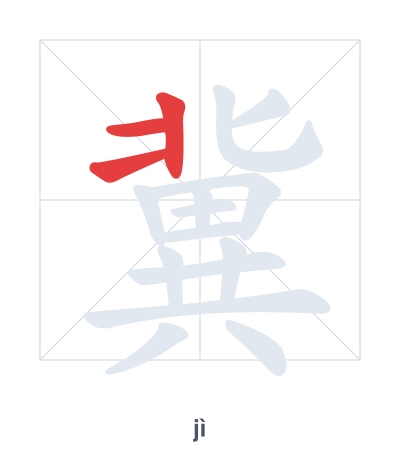
Open Hanzi Writer to see the animated stroke order and practice writing 冀 with real-time feedback.
The character 冀 (jì) is written with 16 strokes. Follow the standard Chinese stroke order: top to bottom, left to right, outside before inside. The radical 八 is one of its key components.
Practice the correct stroke order with the Hanzi Writer app to see animated stroke-by-stroke guidance with real-time feedback.
冀 means hope; wish.
| Character | 冀 |
| Pinyin | jì (ji) |
| Meaning | hope; wish |
| Strokes | 16 |
| Radical | 八 |
| Difficulty | 3.5/5 |
In ancient oracle bone script, 冀 depicted a person with an elaborate headdress, possibly a shaman performing a hopeful ritual. This image evolved to represent 'hope' or 'wish' as an aspiration.
💡 Memory Tip: Two people (北) stand together in a field (田) hoping for rain (共).
他希冀获得成功。
tā xī jì huò dé chéng gōng
He hopes to achieve success.
父母对他有很大冀望。
fù mǔ duì tā yǒu hěn dà jì wàng
His parents have high hopes for him.
人们冀求世界和平。
rén men jì qiú shì jiè hé píng
People long for world peace.
Open Hanzi Writer to see the animated stroke order and practice writing 冀 with real-time feedback.
✨ Animated stroke order · Handwriting recognition · HSK-graded practice · Free to use
The character 冀 is made up of three parts: 北 (north), 田 (field), and 共 (together). While the components do not directly create the meaning "hope," they can be interpreted as people working together in northern fields, hoping for a good harvest. This structural breakdown helps learners remember the character by linking its shape to a hopeful image.