嘴 (zuǐ) means "mouth" in Chinese. It has 16 strokes with the radical 口, and is HSK Level 2.
Rated 3.7/5 in difficulty (challenging).
Harder than 72% of HSK Level 2 characters.
Appears in 3+ common words including 嘴巴 (zuǐ bā), 闭嘴 (bì zuǐ), 张嘴 (zhāng zuǐ).
Due to its 16 strokes, Hanzi Writer's error detection shows 嘴 requires focused practice — most learners need 10+ attempts for consistent accuracy.
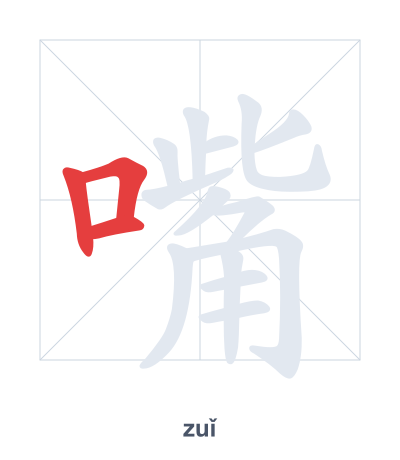
Open Hanzi Writer to see the animated stroke order and practice writing 嘴 with real-time feedback.
The character 嘴 (zuǐ) is written with 16 strokes. Follow the standard Chinese stroke order: top to bottom, left to right, outside before inside. The radical 口 is one of its key components.
Practice the correct stroke order with the Hanzi Writer app to see animated stroke-by-stroke guidance with real-time feedback.
嘴 means mouth.
As an HSK Level 2 character, 嘴 is among the first characters beginners learn.
嘴 is a phono-semantic compound. The left radical 口 (mouth) indicates the meaning, while the right component 觜 (zī) provides the sound and originally referred to a bird's beak or mouth. Together they form the character for 'mouth', especially of animals or humans.
💡 Memory Tip: Picture a bird's beak (觜) opening wide as its mouth (口) to chirp, reminding you that 嘴 means mouth.
他的嘴巴很大。
tā de zuǐ bā hěn dà
His mouth is very big.
请你闭嘴。
qǐng nǐ bì zuǐ
Please shut up.
请张嘴看医生。
qǐng zhāng zuǐ kàn yī shēng
Please open your mouth for the doctor.
Open Hanzi Writer to see the animated stroke order and practice writing 嘴 with real-time feedback.
✨ Animated stroke order · Handwriting recognition · HSK-graded practice · Free to use
嘴 is made of the radical 口 (mouth) on the left and the component 觜 (beak) on the right. The left part directly shows that the character relates to the mouth, while the right part originally meant a bird's beak, reinforcing the idea of an opening for eating or speaking.