噫 (yī) means "alas or oh" in Chinese. It has 16 strokes with the radical 口.
Rated 4.2/5 in difficulty (advanced).
Appears in 1+ common words including 噫 (yī).
Due to its 16 strokes, Hanzi Writer's error detection shows 噫 requires focused practice — most learners need 10+ attempts for consistent accuracy.
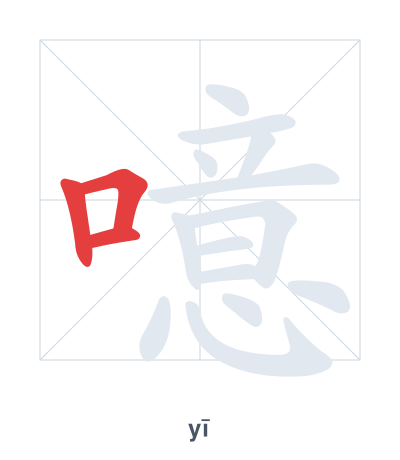
Open Hanzi Writer to see the animated stroke order and practice writing 噫 with real-time feedback.
The character 噫 (yī) is written with 16 strokes. Follow the standard Chinese stroke order: top to bottom, left to right, outside before inside. The radical 口 is one of its key components.
Practice the correct stroke order with the Hanzi Writer app to see animated stroke-by-stroke guidance with real-time feedback.
噫 means alas or oh.
噫 is a compound character combining the mouth radical 口 with 意 (yì, 'thought' or 'meaning'), which itself consists of 音 (sound) and 心 (heart). It functions as a phono-semantic compound where 口 indicates an exclamation and 意 provides the sound and the sense of a heartfelt sigh, often used as an interjection of lament or surprise in Classical Chinese.
💡 Memory Tip: Picture a mouth (口) emitting a heartfelt sigh 'yī' as a heavy thought (意) of sound (音) from the heart (心) escapes in dismay.
噫,你怎么在这儿?
yī nǐ zěn me zài zhè ér
Hey, what are you doing here?
噫,这事真奇怪。
yī zhè shì zhēn qí guài
Oh, this is really strange.
噫,好香啊。
yī hǎo xiāng a
Oh, it smells so good.
Open Hanzi Writer to see the animated stroke order and practice writing 噫 with real-time feedback.
✨ Animated stroke order · Handwriting recognition · HSK-graded practice · Free to use
噫 is composed of the radical 口 (mouth) on the left and the phonetic component 意 (yì, meaning) on the right. The radical 口 suggests that the character is related to sounds or exclamations from the mouth. The phonetic part 意 gives a clue to the pronunciation (yī) but does not directly affect the meaning.