儒 (rú) means "Confucian scholar; scholar" in Chinese. It has 16 strokes with the radical 亻, and is HSK Level 7.
Rated 3.9/5 in difficulty (challenging).
Harder than 34% of HSK Level 7 characters.
Appears in 3+ common words including 儒家 (rú jiā), 儒学 (rú xué), 文儒 (wén rú).
Due to its 16 strokes, Hanzi Writer's error detection shows 儒 requires focused practice — most learners need 10+ attempts for consistent accuracy.
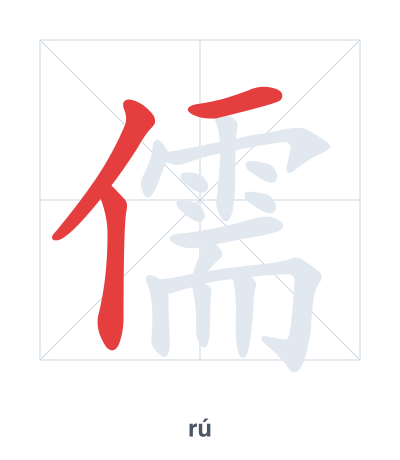
Open Hanzi Writer to see the animated stroke order and practice writing 儒 with real-time feedback.
The character 儒 (rú) is written with 16 strokes. Follow the standard Chinese stroke order: top to bottom, left to right, outside before inside. The radical 亻 is one of its key components.
Practice the correct stroke order with the Hanzi Writer app to see animated stroke-by-stroke guidance with real-time feedback.
儒 means Confucian scholar; scholar.
As an HSK Level 7 character, 儒 is an intermediate-level character.
儒 combines the radical 亻 (person) with 需 (xū, 'need' or 'soft'). Originally it referred to a gentle, yielding person, and later came to denote a Confucian scholar—one who is both learned and soft-spoken, embodying the ideal of a teacher who is needed by society.
💡 Memory Tip: A scholar (亻) who needs (需) endless books to become wise.
这是儒家思想。
zhè shì rú jiā sī xiǎng
This is Confucianism.
他在学习儒学。
tā zài xué xí rú xué
He is studying Confucianism.
他是个文儒。
tā shì gè wén rú
He is a scholar.
Open Hanzi Writer to see the animated stroke order and practice writing 儒 with real-time feedback.
✨ Animated stroke order · Handwriting recognition · HSK-graded practice · Free to use
The character 儒 (rú) is composed of the radical 亻 (person) on the left, and 需 (xū, need) on the right. The person radical indicates a type of person, while 需 originally meant 'to wait' or 'to need,' but here it mainly provides the sound. Together, the structure suggests a person involved in learning or teaching—a Confucian scholar who seeks and imparts knowledge.