撞 (zhuàng) means "to hit; to collide; to bump into" in Chinese. It has 15 strokes with the radical 扌, and is HSK Level 5.
Rated 4.2/5 in difficulty (advanced).
Harder than 73% of HSK Level 5 characters.
Appears in 3+ common words including 撞车 (zhuàng chē), 撞见 (zhuàng jiàn), 撞门 (zhuàng mén).
Due to its 15 strokes, Hanzi Writer's error detection shows 撞 requires focused practice — most learners need 10+ attempts for consistent accuracy.
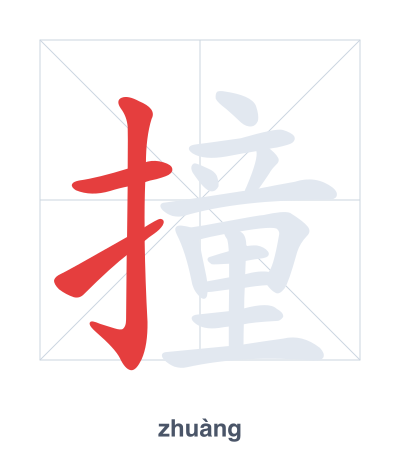
Open Hanzi Writer to see the animated stroke order and practice writing 撞 with real-time feedback.
The character 撞 (zhuàng) is written with 15 strokes. Follow the standard Chinese stroke order: top to bottom, left to right, outside before inside. The radical 扌 is one of its key components.
Practice the correct stroke order with the Hanzi Writer app to see animated stroke-by-stroke guidance with real-time feedback.
撞 means to hit; to collide; to bump into.
As an HSK Level 5 character, 撞 is an intermediate-level character.
撞 is a phono-semantic compound: the radical 扌 (hand) indicates an action performed with the hand, while 童 (child) provides the pronunciation. Together, they convey the idea of striking or bumping into something, often with physical impact.
💡 Memory Tip: Picture a child (童) running headlong into an outstretched hand (扌)—that sudden bump is a collision (撞).
路上发生了撞车。
lù shàng fā shēng le zhuàng chē
A car collision happened on the road.
我撞见他在看书。
wǒ zhuàng jiàn tā zài kàn shū
I happened to see him reading.
别用力撞门。
bié yòng lì zhuàng mén
Don't bang against the door.
Open Hanzi Writer to see the animated stroke order and practice writing 撞 with real-time feedback.
✨ Animated stroke order · Handwriting recognition · HSK-graded practice · Free to use
撞 is a left-right character. The left radical 扌 (hand) indicates the action involves the hand or physical contact. The right part 童 (tóng, child) provides pronunciation and also adds the idea of a child bumping into things.