扛 (gāng/káng) means "to carry on the shoulder" in Chinese. It has 6 strokes with the radical 扌, and is HSK Level 7.
Rated 3.2/5 in difficulty (challenging).
Harder than 10% of HSK Level 7 characters.
Appears in 3+ common words including 扛枪 (káng qiāng), 扛行李 (káng xíng lǐ), 力能扛鼎 (lì néng gāng dǐng).
Due to its 6 strokes, Hanzi Writer's error detection shows 扛 requires focused practice — most learners need 10+ attempts for consistent accuracy.
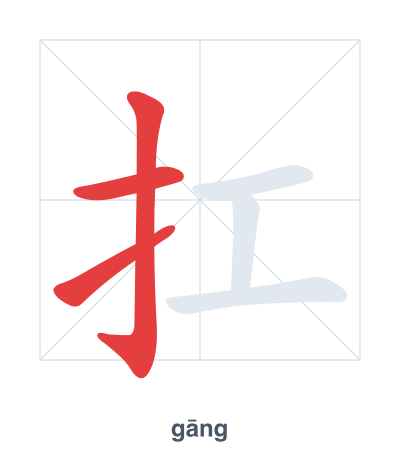
Open Hanzi Writer to see the animated stroke order and practice writing 扛 with real-time feedback.
The character 扛 (gāng/káng) is written with 6 strokes. Follow the standard Chinese stroke order: top to bottom, left to right, outside before inside. The radical 扌 is one of its key components.
Practice the correct stroke order with the Hanzi Writer app to see animated stroke-by-stroke guidance with real-time feedback.
扛 means to carry on the shoulder.
This is a polyphonic character with readings: gāng, káng.
As an HSK Level 7 character, 扛 is an intermediate-level character.
扛 combines the hand radical 扌 with 工 (work/tool), suggesting a hand lifting a heavy tool onto the shoulder. Originally, 工 may have depicted a pole or carrying tool, reinforcing the action of shouldering a load.
💡 Memory Tip: Imagine a worker (工) using his hand (扌) to hoist a heavy sack onto his shoulder to carry it.
守卫边疆的战士们常年扛枪巡逻。
shǒu wèi biān jiāng de zhàn shì men cháng nián káng qiāng xún luó
The soldiers guarding the border carry rifles and patrol all year round.
那个小伙子正热心地帮老人扛行李上楼。
nà ge xiǎo huǒ zi zhèng rè xīn dì bāng lǎo rén káng xíng lǐ shàng lóu
The young man is enthusiastically helping the elderly person carry luggage upstairs.
传说项羽力大无穷,具有力能扛鼎之势。
chuán shuō xiàng yǔ lì dà wú qióng jù yǒu lì néng gāng dǐng zhī shì
Legend has it that Xiang Yu was incredibly strong, with the power to lift a heavy tripod.
Open Hanzi Writer to see the animated stroke order and practice writing 扛 with real-time feedback.
✨ Animated stroke order · Handwriting recognition · HSK-graded practice · Free to use
The character 扛 is made of the radical 扌 (hand) on the left and 工 (work) on the right. The hand radical shows that the action involves using your hand or arm, while 工 gives a clue to the pronunciation (gāng). Together they suggest using your hand to lift something onto your shoulder.