搌 (zhǎn) means "to wipe off; to dab" in Chinese. It has 13 strokes with the radical 扌.
Rated 4.2/5 in difficulty (advanced).
Appears in 3+ common words including 搌布 (zhǎn bù), 搌干 (zhǎn gàn), 搌一下 (zhǎn yī xià).
Due to its 13 strokes, Hanzi Writer's error detection shows 搌 requires focused practice — most learners need 10+ attempts for consistent accuracy.
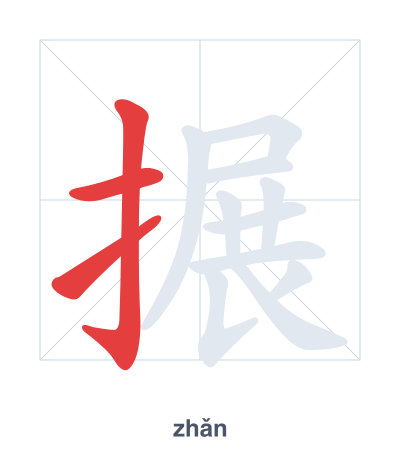
Open Hanzi Writer to see the animated stroke order and practice writing 搌 with real-time feedback.
The character 搌 (zhǎn) is written with 13 strokes. Follow the standard Chinese stroke order: top to bottom, left to right, outside before inside. The radical 扌 is one of its key components.
Practice the correct stroke order with the Hanzi Writer app to see animated stroke-by-stroke guidance with real-time feedback.
搌 means to wipe off; to dab.
搌 combines the hand radical 扌 with 展 (to spread/unfold). The hand performing a spreading motion onto a surface captures the action of wiping or dabbing with a cloth to absorb liquid.
💡 Memory Tip: Imagine your hand (扌) using a giant unfolded napkin (展) to dab up a spill on the table.
用搌布擦擦桌子。
yòng zhǎn bù cā cā zhuō zi
Wipe the table with a cleaning cloth.
把手上的水搌干。
bǎ shǒu shàng de shuǐ zhǎn gàn
Wipe the water off your hands.
拿纸巾搌一下汗。
ná zhǐ jīn zhǎn yī xià hàn
Use a tissue to dab away the sweat.
Open Hanzi Writer to see the animated stroke order and practice writing 搌 with real-time feedback.
✨ Animated stroke order · Handwriting recognition · HSK-graded practice · Free to use
搌 is made of the hand radical 扌 on the left and the component 展 (to spread) on the right. The hand radical suggests an action with the hand, and 展 hints at spreading or dabbing something off. Together, the character means to wipe off or dab, like using a cloth to spread and remove moisture.