搋 (chuāi) means "to knead; to tuck in" in Chinese. It has 13 strokes with the radical 扌.
Rated 4.2/5 in difficulty (advanced).
Appears in 3+ common words including 搋子 (chuāi zi), 搋面 (chuāi miàn), 搋入 (chuāi rù).
Due to its 13 strokes, Hanzi Writer's error detection shows 搋 requires focused practice — most learners need 10+ attempts for consistent accuracy.
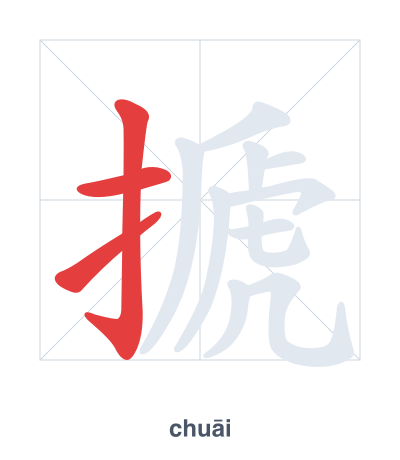
Open Hanzi Writer to see the animated stroke order and practice writing 搋 with real-time feedback.
The character 搋 (chuāi) is written with 13 strokes. Follow the standard Chinese stroke order: top to bottom, left to right, outside before inside. The radical 扌 is one of its key components.
Practice the correct stroke order with the Hanzi Writer app to see animated stroke-by-stroke guidance with real-time feedback.
搋 means to knead; to tuck in.
This compound character combines the hand radical (扌) with the component 㕚 (claw), depicting a hand using claw-like fingers to knead or tuck something in. The claw component suggests pinching or pressing motions involved in kneading dough or tucking fabric.
💡 Memory Tip: Picture a hand (扌) with sharp claws (㕚) kneading dough and then tucking it into a pocket.
马桶堵了用搋子。
mǎ tǒng dǔ le yòng chuāi zi
Use a plunger if the toilet is clogged.
奶奶在厨房搋面。
nǎi nǎi zài chú fáng chuāi miàn
Grandma is kneading dough in the kitchen.
他把钱搋入兜里。
tā bǎ qián chuāi rù dōu lǐ
He stuffed the money into his pocket.
Open Hanzi Writer to see the animated stroke order and practice writing 搋 with real-time feedback.
✨ Animated stroke order · Handwriting recognition · HSK-graded practice · Free to use
The character 搋 is composed of the radical 扌 (hand) on the left, and the component 耑 (meaning 'tip' or 'end') on the right. This structure suggests using the hand to press or push something into a tip or to tuck it in, which matches the meanings 'to knead' (pressing dough) and 'to tuck in' (putting something into a pocket).