见 (jiàn/xiàn) means "to see; to meet" in Chinese. It has 4 strokes with the radical 见, and is HSK Level 1.
Rated 1.9/5 in difficulty (beginner-friendly).
Harder than 18% of HSK Level 1 characters.
Appears in 3+ common words including 看见 (kàn jiàn), 意见 (yì jiàn), 风吹草低见牛羊 (fēng chuī cǎo dī xiàn niú yáng).
In the Hanzi Writer app, most learners master 见 within 3 practice attempts using stroke-by-stroke animation.
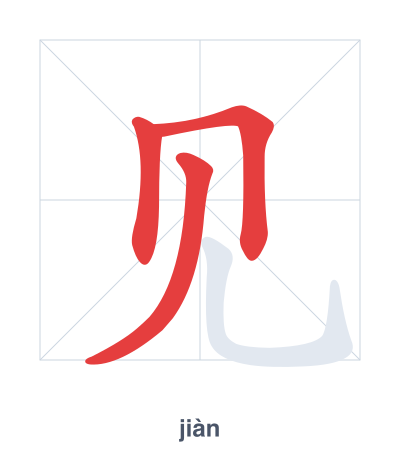
Open Hanzi Writer to see the animated stroke order and practice writing 见 with real-time feedback.
The character 见 (jiàn/xiàn) is written with 4 strokes. Follow the standard Chinese stroke order: top to bottom, left to right, outside before inside. The radical 见 is one of its key components.
Practice the correct stroke order with the Hanzi Writer app to see animated stroke-by-stroke guidance with real-time feedback.
见 means to see; to meet.
This is a polyphonic character with readings: jiàn, xiàn.
As an HSK Level 1 character, 见 is among the first characters beginners learn.
In ancient oracle bone script, 见 depicted a large eye (目) on top of a kneeling person (儿), emphasizing the act of seeing. Over time, the form simplified to the current 4-stroke character, where the top part still suggests an eye and the bottom represents a person.
💡 Memory Tip: Picture a person (儿) with a giant eye (目) on top, constantly scanning around to 'see' everything.
我刚才看见他在草坪上专注地画素描。
wǒ gāng cái kàn jiàn tā zài cǎo píng shàng zhuān zhù dì huà sù miáo
I just saw him focusing on sketching on the lawn.
如果你有不同意见,欢迎随时提出来。
rú guǒ nǐ yǒu bù tóng yì jiàn huān yíng suí shí tí chū lái
If you have a different opinion, feel free to bring it up at any time.
天苍苍,野茫茫,风吹草低见牛羊。
tiān cāng cāng yě máng máng fēng chuī cǎo dī xiàn niú yáng
The sky is blue, the wild is vast; the wind blows, the grass bends, and the cattle and sheep appear.
Open Hanzi Writer to see the animated stroke order and practice writing 见 with real-time feedback.
✨ Animated stroke order · Handwriting recognition · HSK-graded practice · Free to use
见 is both a character and a radical. Its original form depicts a person with a large eye, emphasizing the act of seeing. This visual connection directly relates to its meanings 'to see' and 'to meet'.