扢 (gǔ) means "to rub or dust" in Chinese. It has 6 strokes with the radical 扌.
Rated 3.2/5 in difficulty (challenging).
Appears in 3+ common words including 扢扎 (gǔ zhā), 扢打 (gǔ dǎ), 扢弄 (gǔ nòng).
Due to its 6 strokes, Hanzi Writer's error detection shows 扢 requires focused practice — most learners need 10+ attempts for consistent accuracy.
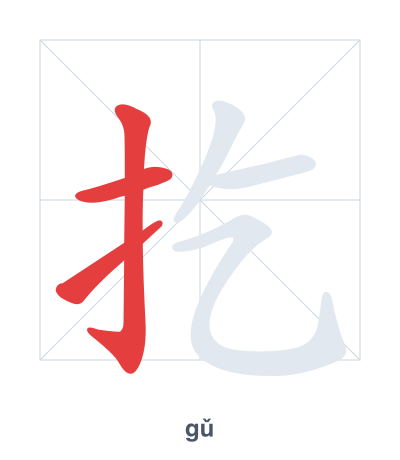
Open Hanzi Writer to see the animated stroke order and practice writing 扢 with real-time feedback.
The character 扢 (gǔ) is written with 6 strokes. Follow the standard Chinese stroke order: top to bottom, left to right, outside before inside. The radical 扌 is one of its key components.
Practice the correct stroke order with the Hanzi Writer app to see animated stroke-by-stroke guidance with real-time feedback.
扢 means to rub or dust.
扢 combines the hand radical 扌 with 乞 (qǐ, meaning to beg), which serves as a phonetic component. The meaning 'to rub or dust' derives from the hand's action of cleaning or wiping, possibly linked to the idea of wiping away dirt from a supplicant.
💡 Memory Tip: Imagine a hand (扌) vigorously dusting off a grimy beggar (乞) to make him presentable.
她在扢扎头发。
tā zài gǔ zhā tóu fà
She is tying up her hair.
扢打一下衣服。
gǔ dǎ yī xià yī fú
Dust off the clothes.
别乱扢弄东西。
bié luàn gǔ nòng dōng xī
Don't fiddle with things.
Open Hanzi Writer to see the animated stroke order and practice writing 扢 with real-time feedback.
✨ Animated stroke order · Handwriting recognition · HSK-graded practice · Free to use
扢 uses the radical 扌 (hand), which tells you the meaning involves hand actions. The right side is 乞 (qǐ), which gives a phonetic hint for the pronunciation gǔ. Together, the hand radical plus the phonetic component creates a character meaning to rub or dust with your hand.