払 (fǎn) means "to shake off or dust" in Chinese. It has 5 strokes with the radical 扌.
Rated 2.9/5 in difficulty (moderate).
Appears in 3+ common words including 払拭 (fǎn shì), 払云 (fǎn yún), 払袖 (fǎn xiù).
Hanzi Writer's stroke validation shows learners typically need 5-8 attempts to write 払 with correct proportion and order.
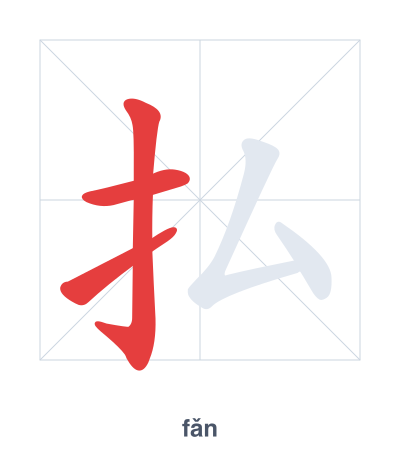
Open Hanzi Writer to see the animated stroke order and practice writing 払 with real-time feedback.
The character 払 (fǎn) is written with 5 strokes. Follow the standard Chinese stroke order: top to bottom, left to right, outside before inside. The radical 扌 is one of its key components.
Practice the correct stroke order with the Hanzi Writer app to see animated stroke-by-stroke guidance with real-time feedback.
払 means to shake off or dust.
払 is a Japanese simplified variant of 拂 (fú 'to brush off'), combining the hand radical 扌 with a stylized bent stroke that visually suggests the motion of flicking or shaking away a speck of dust. The original 拂 used 弗 as a phonetic component, but this simplified form directly depicts a hand performing a quick sweeping action.
💡 Memory Tip: Picture your hand (扌) flicking a tiny, bent piece of dust (the curved stroke on the right) off your sleeve with a quick shake.
他在払拭桌子。
tā zài fǎn shì zhuō zi
He is wiping the table.
高山仿佛払云。
gāo shān fǎng fú fǎn yún
The high mountains seem to brush the clouds.
他払袖而去了。
tā fǎn xiù ér qù le
He flicked his sleeves and left.
Open Hanzi Writer to see the animated stroke order and practice writing 払 with real-time feedback.
✨ Animated stroke order · Handwriting recognition · HSK-graded practice · Free to use
The character 払 consists of the radical 扌 (hand) on the left and a hook-shaped stroke 乚 on the right. The hand radical indicates an action done by hand, while the right part suggests a sweeping or flicking motion, together meaning to shake off or dust.