门 (mén) means "door; gate" in Chinese. It has 3 strokes with the radical 门, and is HSK Level 1.
Rated 1.7/5 in difficulty (beginner-friendly).
Harder than 10% of HSK Level 1 characters.
Appears in 3+ common words including 门口 (mén kǒu), 开门 (kāi mén), 门票 (mén piào).
In the Hanzi Writer app, most learners master 门 within 3 practice attempts using stroke-by-stroke animation.
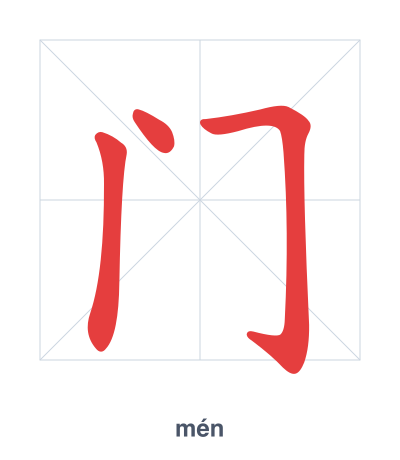
Open Hanzi Writer to see the animated stroke order and practice writing 门 with real-time feedback.
The character 门 (mén) is written with 3 strokes. Follow the standard Chinese stroke order: top to bottom, left to right, outside before inside. The radical 门 is one of its key components.
Practice the correct stroke order with the Hanzi Writer app to see animated stroke-by-stroke guidance with real-time feedback.
门 means door; gate.
As an HSK Level 1 character, 门 is among the first characters beginners learn.
门 is a pictograph of a double-leaf door. The ancient oracle bone script depicted two vertical leaves meeting at a top hinge, resembling a simple gate. Over time, the form simplified to the modern 3-stroke shape, still evoking the outline of an open doorway.
💡 Memory Tip: Imagine the character 门 as a pair of swinging saloon doors seen from above, with the two side strokes as the doorposts and the top stroke as the hinge connecting them.
我在门口等你。
wǒ zài mén kǒu děng nǐ
I'm waiting for you at the entrance.
请帮我开门。
qǐng bāng wǒ kāi mén
Please help me open the door.
这里的门票很贵。
zhè lǐ de mén piào hěn guì
The entrance tickets here are very expensive.
Open Hanzi Writer to see the animated stroke order and practice writing 门 with real-time feedback.
✨ Animated stroke order · Handwriting recognition · HSK-graded practice · Free to use
The character 门 is a pictogram that originally depicted a pair of swinging doors with a bar across the middle. Its simple shape directly represents the concept of a door or gate, making it one of the most basic and intuitive characters in Chinese.