才 (cái) means "Talent, or 'only then', or 'just now'." in Chinese. It has 3 strokes with the radical 扌, and is HSK Level 2.
Rated 1.9/5 in difficulty (beginner-friendly).
Harder than 7% of HSK Level 2 characters.
Appears in 3+ common words including 刚才 (gāng cái), 天才 (tiān cái), 才华 (cái huá).
In the Hanzi Writer app, most learners master 才 within 3 practice attempts using stroke-by-stroke animation.
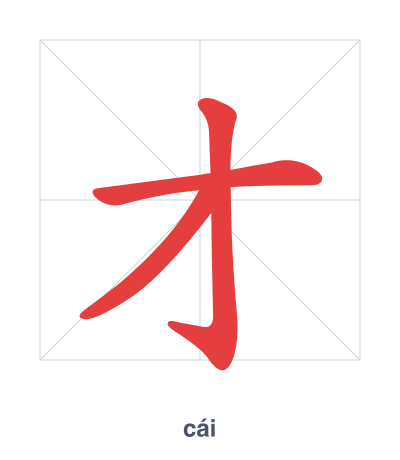
Open Hanzi Writer to see the animated stroke order and practice writing 才 with real-time feedback.
The character 才 (cái) is written with 3 strokes. Follow the standard Chinese stroke order: top to bottom, left to right, outside before inside. The radical 扌 is one of its key components.
Practice the correct stroke order with the Hanzi Writer app to see animated stroke-by-stroke guidance with real-time feedback.
才 means Talent, or 'only then', or 'just now'..
As an HSK Level 2 character, 才 is among the first characters beginners learn.
才 is a pictograph of a sprouting plant, with the horizontal line representing the ground and the vertical stroke showing a shoot emerging, symbolizing inherent potential or talent. The character later extended to mean 'only then' or 'just now' as an adverb indicating a conditional or temporal sequence.
💡 Memory Tip: Imagine a tiny green sprout (才) pushing through the soil—its three strokes are the first signs of talent bursting forth just now.
他刚才出去了。
tā gāng cái chū qù le
He just went out.
他是一个数学天才。
tā shì yí gè shù xué tiān cái
He is a math genius.
他很有才华。
tā hěn yǒu cái huá 。
He is very talented.
Open Hanzi Writer to see the animated stroke order and practice writing 才 with real-time feedback.
✨ Animated stroke order · Handwriting recognition · HSK-graded practice · Free to use
才 is a simple pictograph of a plant sprouting through the ground, symbolizing the emergence of talent or ability. Its three strokes do not break into smaller radicals, but the radical 扌 (hand) is assigned for dictionary lookup, even though the meaning is not related to hands.