厌 (yàn) means "to loathe; to be tired of" in Chinese. It has 6 strokes with the radical 厂, and is HSK Level 5.
Rated 2.9/5 in difficulty (moderate).
Harder than 8% of HSK Level 5 characters.
Appears in 3+ common words including 讨厌 (tǎo yàn), 厌倦 (yàn juàn), 厌食 (yàn shí).
Hanzi Writer's stroke validation shows learners typically need 5-8 attempts to write 厌 with correct proportion and order.
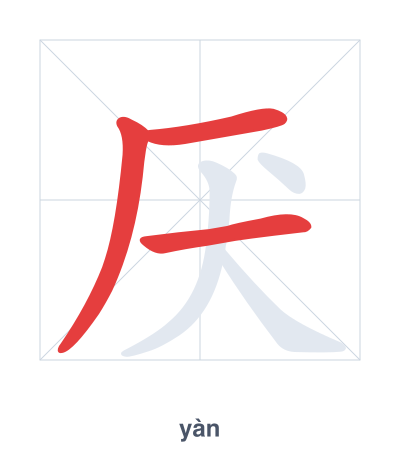
Open Hanzi Writer to see the animated stroke order and practice writing 厌 with real-time feedback.
The character 厌 (yàn) is written with 6 strokes. Follow the standard Chinese stroke order: top to bottom, left to right, outside before inside. The radical 厂 is one of its key components.
Practice the correct stroke order with the Hanzi Writer app to see animated stroke-by-stroke guidance with real-time feedback.
厌 means to loathe; to be tired of.
As an HSK Level 5 character, 厌 is an intermediate-level character.
The character 厌 originally depicted a dog (犬) under a cliff (厂), symbolizing a situation where the dog is trapped or overwhelmed, leading to feelings of being fed up or satiated, which later extended to loathing and being tired of something.
💡 Memory Tip: Picture a bored dog (犬) lying under a cliff (厂), too tired and disgusted to move.
我讨厌下雨天。
wǒ tǎo yàn xià yǔ tiān
I hate rainy days.
他厌倦了加班。
tā yàn juàn le jiā bān
He is tired of working overtime.
弟弟最近有点厌食。
dì di zuì jìn yǒu diǎn yàn shí
Little brother has had a poor appetite lately.
Open Hanzi Writer to see the animated stroke order and practice writing 厌 with real-time feedback.
✨ Animated stroke order · Handwriting recognition · HSK-graded practice · Free to use
厌 is made of the radical 厂 (cliff) on top and 犬 (dog) below. The original meaning relates to pressing down or oppression, which connects to feelings of being tired of or loathing something. The dog under a cliff suggests a trapped, uncomfortable situation.