食 (shí) means "to eat / food" in Chinese. It has 9 strokes with the radical 食, and is HSK Level 2.
Rated 2.8/5 in difficulty (moderate).
Harder than 32% of HSK Level 2 characters.
Appears in 3+ common words including 食物 (shí wù), 食谱 (shí pǔ), 面食 (miàn shí).
Hanzi Writer's stroke validation shows learners typically need 5-8 attempts to write 食 with correct proportion and order.
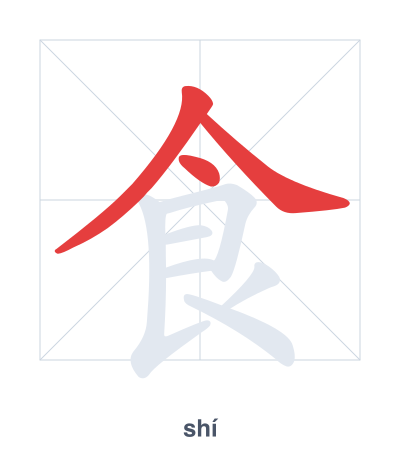
Open Hanzi Writer to see the animated stroke order and practice writing 食 with real-time feedback.
The character 食 (shí) is written with 9 strokes. Follow the standard Chinese stroke order: top to bottom, left to right, outside before inside. The radical 食 is one of its key components.
Practice the correct stroke order with the Hanzi Writer app to see animated stroke-by-stroke guidance with real-time feedback.
食 means to eat / food.
As an HSK Level 2 character, 食 is among the first characters beginners learn.
Originally a pictograph of a lid (亼) over a vessel filled with grain (皀), symbolizing food stored in a container. Over time, the vessel component simplified into the lower part of 食, retaining the core idea of eating or food.
💡 Memory Tip: Picture a chef's hat (亼) on top of a steaming bowl of rice (the lower part shaped like a bowl with grains) ready to eat.
这里的食物很好吃。
zhè lǐ de shí wù hěn hǎo chī
The food here is very delicious.
我在看新的食谱。
wǒ zài kàn xīn de shí pǔ
I am looking at a new recipe.
北方人喜欢吃面食。
běi fāng rén xǐ huān chī miàn shí
Northerners like to eat wheaten food (noodles, dumplings, etc.).
Open Hanzi Writer to see the animated stroke order and practice writing 食 with real-time feedback.
✨ Animated stroke order · Handwriting recognition · HSK-graded practice · Free to use
The character 食 is both a radical and a standalone character. Its shape originally came from a picture of a food vessel with a lid, directly linking it to the ideas of food and eating.