历 (lì) means "history or to experience" in Chinese. It has 4 strokes with the radical 厂, and is HSK Level 3.
Rated 2.4/5 in difficulty (moderate).
Harder than 7% of HSK Level 3 characters.
Appears in 3+ common words including 历史 (lì shǐ), 日历 (rì lì), 经历 (jīng lì).
Hanzi Writer's stroke validation shows learners typically need 5-8 attempts to write 历 with correct proportion and order.
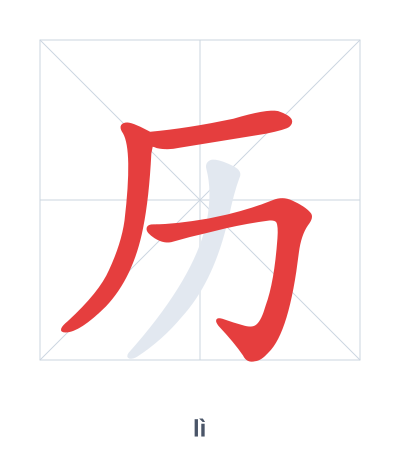
Open Hanzi Writer to see the animated stroke order and practice writing 历 with real-time feedback.
The character 历 (lì) is written with 4 strokes. Follow the standard Chinese stroke order: top to bottom, left to right, outside before inside. The radical 厂 is one of its key components.
Practice the correct stroke order with the Hanzi Writer app to see animated stroke-by-stroke guidance with real-time feedback.
历 means history or to experience.
As an HSK Level 3 character, 历 is an intermediate-level character.
历 combines the cliff radical 厂 with 力 (strength), picturing the effort needed to climb a cliff—a metaphor for enduring experiences that form history.
💡 Memory Tip: Imagine using all your strength (力) to scale a steep cliff (厂) to witness a historical event firsthand.
我喜欢学历史。
wǒ xǐ huān xué lì shǐ
I like studying history.
墙上挂着日历。
qiáng shàng guà zhe rì lì
A calendar is hanging on the wall.
这是一次好经历。
zhè shì yī cì hǎo jīng lì
This is a good experience.
Open Hanzi Writer to see the animated stroke order and practice writing 历 with real-time feedback.
✨ Animated stroke order · Handwriting recognition · HSK-graded practice · Free to use
历 combines the radical 厂 (cliff or factory) on the outside and 力 (lì, strength) inside. The cliff represents a place or time, and strength suggests going through or enduring experiences, which connects to the meanings of history and experiencing.