厄 (è) means "adversity or hardship" in Chinese. It has 4 strokes with the radical 厂, and is HSK Level 7.
Rated 2.4/5 in difficulty (moderate).
Harder than 2% of HSK Level 7 characters.
Appears in 3+ common words including 厄运 (è yùn), 困厄 (kùn è), 灾厄 (zāi è).
Hanzi Writer's stroke validation shows learners typically need 5-8 attempts to write 厄 with correct proportion and order.
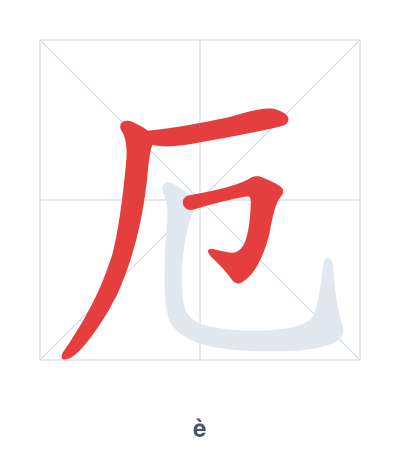
Open Hanzi Writer to see the animated stroke order and practice writing 厄 with real-time feedback.
The character 厄 (è) is written with 4 strokes. Follow the standard Chinese stroke order: top to bottom, left to right, outside before inside. The radical 厂 is one of its key components.
Practice the correct stroke order with the Hanzi Writer app to see animated stroke-by-stroke guidance with real-time feedback.
厄 means adversity or hardship.
As an HSK Level 7 character, 厄 is an intermediate-level character.
厄 combines a cliff (厂) with a kneeling figure (卩, originally a seal or knot), depicting a person trapped in a narrow, dangerous place—like under a cliff or in a yoke. This visual of confinement and pressure evolved to mean hardship or adversity.
💡 Memory Tip: Picture a person kneeling under a rocky cliff (厂) with a heavy yoke around their neck, struggling with life's burdens.
他度过了厄运。
tā dù guò le è yùn
He has made it through his period of misfortune.
生活中会有困厄。
shēng huó zhōng huì yǒu kùn è
There will be hardships in life.
祈求免除灾厄。
qí qiú miǎn chú zāi è
Pray to be spared from disasters.
Open Hanzi Writer to see the animated stroke order and practice writing 厄 with real-time feedback.
✨ Animated stroke order · Handwriting recognition · HSK-graded practice · Free to use
The character 厄 is made of two parts: the top radical 厂 (cliff) and the bottom part 卩 (a kneeling person). Together, they suggest a person trapped under a cliff, representing a difficult or dangerous situation. This image gives the meaning of adversity or hardship.