仄 (zè) means "Oblique tone; narrow" in Chinese. It has 4 strokes with the radical 厂.
Rated 2.4/5 in difficulty (moderate).
Appears in 3+ common words including 平仄 (píng zè), 仄声 (zè shēng), 仄径 (zè jìng).
Hanzi Writer's stroke validation shows learners typically need 5-8 attempts to write 仄 with correct proportion and order.
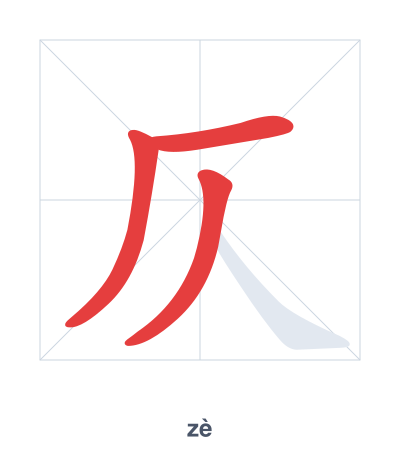
Open Hanzi Writer to see the animated stroke order and practice writing 仄 with real-time feedback.
The character 仄 (zè) is written with 4 strokes. Follow the standard Chinese stroke order: top to bottom, left to right, outside before inside. The radical 厂 is one of its key components.
Practice the correct stroke order with the Hanzi Writer app to see animated stroke-by-stroke guidance with real-time feedback.
仄 means Oblique tone; narrow.
| Character | 仄 |
| Pinyin | zè (ze) |
| Meaning | Oblique tone; narrow |
| Strokes | 4 |
| Radical | 厂 |
| Difficulty | 2.4/5 |
Ancient script showed a person (人) squeezed under a cliff (厂), representing a narrow or slanted space—hence the meanings 'narrow' and 'oblique tone'.
💡 Memory Tip: Picture a person (人) leaning awkwardly under a cliff (厂), cramped into a narrow, slanted spot.
写诗要注意平仄。
xiě shī yào zhù yì píng zè
Pay attention to tonal patterns when writing poetry.
这个字读作仄声。
zhè ge zì dú zuò zè shēng
This character is pronounced in the oblique tone.
我们走在山间仄径。
wǒ men zǒu zài shān jiān zè jìng
We are walking on a narrow mountain path.
Open Hanzi Writer to see the animated stroke order and practice writing 仄 with real-time feedback.
✨ Animated stroke order · Handwriting recognition · HSK-graded practice · Free to use
The character 仄 is composed of the radical 厂 (cliff) on top and a modified form of 人 (person) inside. The person appears to be leaning or cramped under a cliff, suggesting the ideas of 'oblique' or 'narrow' space. This structure visually implies a slanted or restricted position, matching the character's meanings in poetry tone and narrowness.