歇 (xiē) means "to rest; to stop" in Chinese. It has 13 strokes with the radical 欠, and is HSK Level 5.
Rated 4.2/5 in difficulty (advanced).
Harder than 77% of HSK Level 5 characters.
Appears in 3+ common words including 歇息 (xiē xī), 歇会儿 (xiē huì er), 间歇 (jiàn xiē).
Due to its 13 strokes, Hanzi Writer's error detection shows 歇 requires focused practice — most learners need 10+ attempts for consistent accuracy.
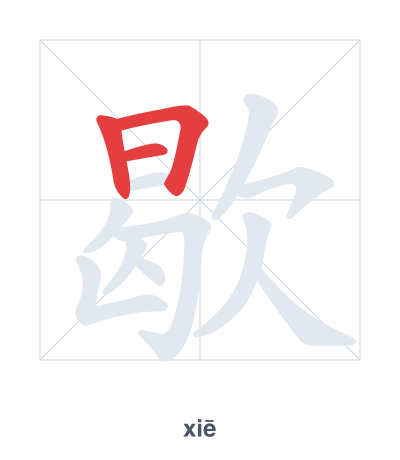
Open Hanzi Writer to see the animated stroke order and practice writing 歇 with real-time feedback.
The character 歇 (xiē) is written with 13 strokes. Follow the standard Chinese stroke order: top to bottom, left to right, outside before inside. The radical 欠 is one of its key components.
Practice the correct stroke order with the Hanzi Writer app to see animated stroke-by-stroke guidance with real-time feedback.
歇 means to rest; to stop.
As an HSK Level 5 character, 歇 is an intermediate-level character.
歇 combines the radical 欠 (mouth open, indicating breath) with the phonetic component 曷, which in ancient texts also carries a sense of stopping or pausing. Together, they depict the act of catching one's breath and halting activity, hence 'to rest' or 'to stop'.
💡 Memory Tip: Imagine a tired man yawning (欠) and asking 'Why?' (曷 sounds like 'why') as he finally stops to rest.
我们坐下歇息吧。
wǒ men zuò xià xiē xī ba
Let's sit down and rest.
累了就歇会儿。
lèi le jiù xiē huì er
If you're tired, rest for a while.
雨有间歇地下着。
yǔ yǒu jiàn xiē dì xià zhe
The rain is falling intermittently.
Open Hanzi Writer to see the animated stroke order and practice writing 歇 with real-time feedback.
✨ Animated stroke order · Handwriting recognition · HSK-graded practice · Free to use
The character 歇 is formed from the left component 曷 (hé, providing sound) and the right radical 欠 (qiàn, meaning 'to yawn' or 'breath'). Together, the idea is to 'stop and breathe out,' which leads to the meaning of resting or taking a break.