剽 (piāo) means "rob or swift" in Chinese. It has 13 strokes with the radical 刂.
Rated 3.9/5 in difficulty (challenging).
Appears in 3+ common words including 剽窃 (piāo qiè), 剽悍 (piāo hàn), 剽取 (piāo qǔ).
Due to its 13 strokes, Hanzi Writer's error detection shows 剽 requires focused practice — most learners need 10+ attempts for consistent accuracy.
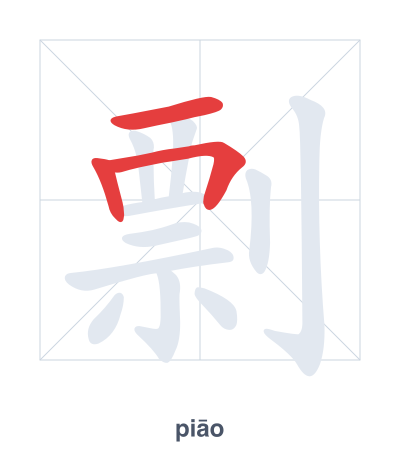
Open Hanzi Writer to see the animated stroke order and practice writing 剽 with real-time feedback.
The character 剽 (piāo) is written with 13 strokes. Follow the standard Chinese stroke order: top to bottom, left to right, outside before inside. The radical 刂 is one of its key components.
Practice the correct stroke order with the Hanzi Writer app to see animated stroke-by-stroke guidance with real-time feedback.
剽 means rob or swift.
剽 is a phono-semantic compound where 刂 (knife) indicates cutting or robbing, and 票 (piào, ticket) provides the sound. The original sense of 'rob' comes from swiftly using a knife to take something, while 'swift' extends from the quick action of such a theft.
💡 Memory Tip: Picture a swift thief (票) slicing a wallet with a knife (刂) to rob it in a flash.
这种剽窃行为不对。
zhè zhǒng piāo qiè xíng wéi bú duì
This kind of plagiarism is wrong.
那个骑手很剽悍。
nà ge qí shǒu hěn piāo hàn
That rider is very tough and agile.
他剽取了别人的想法。
tā piāo qǔ le bié rén de xiǎng fǎ
He plagiarized someone else's ideas.
Open Hanzi Writer to see the animated stroke order and practice writing 剽 with real-time feedback.
✨ Animated stroke order · Handwriting recognition · HSK-graded practice · Free to use
The left part 票 (piào, ticket) gives a hint for pronunciation, while the right radical 刂 (knife) relates to cutting actions. Together they suggest the idea of 'robbing' or 'swiftly taking' by force, like cutting something away with a blade.