催 (cuī) means "to urge; to hurry; to hasten" in Chinese. It has 13 strokes with the radical 亻, and is HSK Level 7.
Rated 3.9/5 in difficulty (challenging).
Harder than 33% of HSK Level 7 characters.
Appears in 3+ common words including 催促 (cuī cù), 催眠 (cuī mián), 催缴 (cuī jiǎo).
Due to its 13 strokes, Hanzi Writer's error detection shows 催 requires focused practice — most learners need 10+ attempts for consistent accuracy.
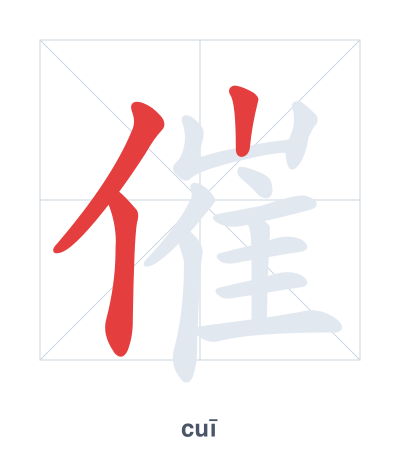
Open Hanzi Writer to see the animated stroke order and practice writing 催 with real-time feedback.
The character 催 (cuī) is written with 13 strokes. Follow the standard Chinese stroke order: top to bottom, left to right, outside before inside. The radical 亻 is one of its key components.
Practice the correct stroke order with the Hanzi Writer app to see animated stroke-by-stroke guidance with real-time feedback.
催 means to urge; to hurry; to hasten.
As an HSK Level 7 character, 催 is an intermediate-level character.
催 is a phono-semantic compound. The left side is the person radical (亻), indicating a human action, while the right side 崔 (cuī) provides the pronunciation. The character visualizes a person urging or pressing another to move faster, like a taskmaster hurrying a worker.
💡 Memory Tip: Imagine a person (亻) standing on a mountain (山) yelling at a bird (隹) to hurry up and fly faster.
妈妈催促我快点起床。
mā mā cuī cù wǒ kuài diǎn qǐ chuáng
Mom urged me to get up quickly.
这首歌很有催眠作用。
zhè shǒu gē hěn yǒu cuī mián zuò yòng
This song is very hypnotic.
房东在催缴房租。
fáng dōng zài cuī jiǎo fáng zū
The landlord is pressing for the rent.
Open Hanzi Writer to see the animated stroke order and practice writing 催 with real-time feedback.
✨ Animated stroke order · Handwriting recognition · HSK-graded practice · Free to use
催 is composed of the radical 亻 (person) on the left and the phonetic component 崔 on the right. The right side 崔 contains 山 (mountain) and 隹 (short-tailed bird), which together mainly provide the pronunciation. The meaning 'to urge' comes from the person radical, suggesting someone pushing or hurrying another.